A-level Physics Year 12 · Topic 4
Forces, moments and materials
Forces, moments and materials is about how forces combine, how objects balance, and how materials stretch and break.
We will add and resolve vectors, use moments, couples and the conditions for equilibrium, and find centres of mass.
Then we study Hooke's law, stress, strain and the Young modulus, and the energy stored when materials are stretched.
- 3 subtopics
- 144 questions
- Free: 4.1 notes and 10 questions
In this topic
- 4.1Scalars, vectors and momentsFree below · 47 questions
- 4.2Centre of mass, couples and equilibrium of coplanar forcesOpen in Full Marks · 77 questions
- 4.3MaterialsOpen in Full Marks · 20 questions
4.1 · Free notes
Scalars, vectors and moments
Key points
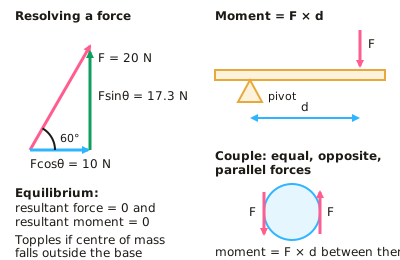
- Vectors have magnitude and direction; they can be added using scale drawings or by resolving into perpendicular components (Fcosθ and Fsinθ).
- An object is in equilibrium when the resultant force and resultant moment are both zero.
- Moment = force × perpendicular distance from the pivot. A couple is a pair of equal, opposite, parallel forces whose moment = force × perpendicular distance between them.
- The centre of mass is the point where the object's weight appears to act; an object topples when its centre of mass falls outside the base.
In more detail
- Worked resolving: a 200 N force at 35° above the horizontal → horizontal 200 cos 35° = 164 N; vertical 200 sin 35° = 115 N.
- Worked vector addition: 6.0 N east + 8.0 N north → resultant 10 N at 53° north of east.
- Inclined plane: weight resolves into mg sin θ down the slope and mg cos θ perpendicular to it; e.g. 50 N on a 30° slope → 25 N down the slope.
- Worked moment: a 20 N force applied 0.30 m from a hinge at right angles gives a moment of 6.0 N m.
Practice
Scalars, vectors and moments: 10 questions
Pick an answer to check it, or open the answer for the explanation.
1. A 20 N force acts at 60° to the horizontal. What is its horizontal component?
- 10 N
- 17.3 N
- 20 N
- 34.6 N
Show answer
A: 10 N. Horizontal component = 20 cos60° = 10 N.
2. An object is in equilibrium when:
- The forces are large
- The resultant force and resultant moment are both zero
- It is moving
- It is at rest only
Show answer
B: The resultant force and resultant moment are both zero. An object moving at constant velocity can also be in equilibrium.
3. What is a couple?
- A single force
- Two equal, opposite, parallel forces that produce a turning effect
- Two forces acting at a point
- The weight of an object
Show answer
B: Two equal, opposite, parallel forces that produce a turning effect. A couple produces rotation with no resultant force.
4. Where does an object's weight appear to act?
- At its highest point
- At its centre of mass
- At its base
- At its edge
Show answer
B: At its centre of mass. This is the point used in moment calculations.
5. What is the moment of a 15 N force acting 0.4 m perpendicular from a pivot?
- 0.027 Nm
- 6 Nm
- 15 Nm
- 37.5 Nm
Show answer
B: 6 Nm. M = Fd = 15 × 0.4 = 6 Nm.
6. A force of 12 N acts at 30° above the horizontal. What is its vertical component?
- 6 N
- 10.4 N
- 12 N
- 20.8 N
Show answer
A: 6 N. Vertical component = 12 sin30° = 6 N.
7. Which of the following is a vector quantity?
- Mass
- Energy
- Displacement
- Speed
Show answer
C: Displacement. Displacement has both magnitude and direction, so it is a vector. Speed, energy and mass have magnitude only, so they are scalars.
8. Forces of 3.0 N and 4.0 N act at right angles to each other on an object. What is the magnitude of the resultant force?
- 7.0 N
- 1.0 N
- 5.0 N
- 12 N
Show answer
C: 5.0 N. For perpendicular vectors, R = √(3.0² + 4.0²) = √25 = 5.0 N. Adding the magnitudes (7.0 N) is only correct for forces in the same direction.
9. A 50 N force acts at 40° above the horizontal. What is its horizontal component?
- 50 N
- 38 N
- 32 N
- 65 N
Show answer
B: 38 N. The horizontal component is F cosθ = 50 cos 40° = 38 N. 32 N is F sinθ, the vertical component.
10. A boat heads directly across a river at 3.0 m/s relative to the water. The river flows at 4.0 m/s. What is the boat's speed relative to the bank?
- 3.5 m/s
- 7.0 m/s
- 1.0 m/s
- 5.0 m/s
Show answer
D: 5.0 m/s. The velocities are perpendicular, so the resultant speed is √(3.0² + 4.0²) = 5.0 m/s.
Keep going in Full Marks
Full Marks has 47 questions on Scalars, vectors and moments (37 more than here), set out in practice levels. You also get notes and 3D models for all 3 subtopics of Forces, moments and materials, plus games, timed exams and past papers.