A-level Biology Year 12 · Topic 7
Practical and mathematical skills
Practical and mathematical skills make up a big share of the marks in A-level Biology, across every paper.
We will plan investigations, choose apparatus and techniques like serial dilution, colorimetry and chromatography, and present data in tables and graphs.
Then we tackle the maths and statistics: standard form, logarithms, standard deviation, t-tests, chi-squared and Spearman's rank, and finish with how to evaluate methods and evidence.
- 7 subtopics
- 304 questions
- Free: 7.1 notes and 10 questions
In this topic
- 7.1Planning and designing investigations: variables, controls, risk assessment and ethicsFree below · 35 questions
- 7.2Apparatus and techniques: measurement, serial dilution, colorimetry, chromatography and vitamin C (DCPIP) titrationOpen in Full Marks · 26 questions
- 7.3Processing and presenting data: tables, graphs, rates, gradients and percentage changeOpen in Full Marks · 67 questions
- 7.4Mathematical skills: SI units, standard form, ratios, logarithms, surface area and volume, and magnification calculationsOpen in Full Marks · 49 questions
- 7.5Statistical tests: mean, standard deviation, error bars, t-test, chi-squared and correlation (Spearman's rank)Open in Full Marks · 59 questions
- 7.6Uncertainty, accuracy, precision, validity and reliabilityOpen in Full Marks · 32 questions
- 7.7Drawing conclusions and evaluating methods, evidence and sourcesOpen in Full Marks · 36 questions
7.1 · Free notes
Planning and designing investigations: variables, controls, risk assessment and ethics
Key points
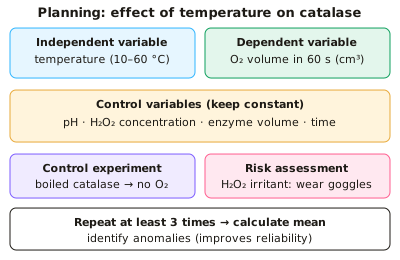
- The independent variable (IV) is the one you deliberately change. The dependent variable (DV) is the one you measure. State both with units and say how each will be measured.
- Control variables (e.g. temperature, pH, concentration, volume, time) are kept constant so any change in the DV is due only to the IV. This makes the investigation valid.
- A control experiment (e.g. boiled enzyme, or distilled water in place of the test solution) shows that the effect is caused by the IV and not by some other factor.
- Choose a suitable range and intervals for the IV (at least five values). A pilot study helps decide the range, volumes, concentrations and timings before the main investigation.
- Repeats (at least three) allow a mean to be calculated and anomalous results to be identified. This improves reliability (repeatability).
- Accuracy is closeness to the true value. Precision is closeness of repeated measurements to each other. Resolution is the smallest division the instrument can measure.
- Random sampling (e.g. random number tables to give grid coordinates for quadrats) avoids bias in fieldwork. A belt transect is used to sample systematically along an environmental gradient.
- A hypothesis must be testable and predict the outcome, using biological reasoning. The null hypothesis states there is no significant difference or correlation, and it is the one tested statistically.
- In a risk assessment, identify each hazard (anything that could cause harm), judge the risk (likelihood and severity of harm) and state a control measure (e.g. goggles, gloves, disinfectant, aseptic technique).
- Ethics: for animals apply the 3Rs (replace, reduce, refine). For human volunteers obtain informed consent, keep data confidential and allow the right to withdraw. In fieldwork, minimise damage to habitats and return organisms.
- In evaluation, distinguish random errors (scatter in repeats) from systematic errors (consistent bias, e.g. miscalibrated equipment). Suggest improvements such as more precise apparatus, more repeats or a wider range.
In more detail
- Null hypothesis example: 'There is no significant difference between the mean number of stomata on the upper and lower surfaces of the leaf.'
- Pilot study: a quick trial run to choose a suitable range, intervals and timings, and to spot practical problems before the real investigation.
- The 3Rs: Replace animals with alternatives where possible; Reduce the number used; Refine methods to minimise suffering.
- Writing control variables: name the variable and how it is controlled, e.g. 'temperature kept at 30 °C using a thermostatically controlled water bath'.
Practice
Planning and designing investigations: variables, controls, risk assessment and ethics: 10 questions
Pick an answer to check it, or open the answer for the explanation.
1. A student investigates how temperature affects catalase activity by measuring the oxygen produced. What is the dependent variable?
- Volume of oxygen collected in 60 seconds
- Volume of catalase solution used
- Concentration of hydrogen peroxide
- Temperature of the hydrogen peroxide
Show answer
A: Volume of oxygen collected in 60 seconds. The DV is what is measured: the volume of oxygen collected in a set time. Temperature is the IV; peroxide concentration and enzyme volume are control variables.
2. In an investigation into light intensity and the rate of photosynthesis in pondweed, which factor should be kept constant?
- Light intensity
- Distance between lamp and pondweed
- Water temperature
- Number of bubbles per minute
Show answer
C: Water temperature. Temperature affects enzyme activity so must be controlled. Lamp distance is how the IV (light intensity) is changed, and bubble count is the DV.
3. A student adds boiled amylase to starch solution as a control. What is the purpose of this control?
- To act as the independent variable
- To show starch breakdown is caused by active amylase
- To increase the reliability of results
- To keep the temperature constant
Show answer
B: To show starch breakdown is caused by active amylase. Boiled enzyme is denatured, so if no starch breaks down this shows the change in the test is due to active enzyme, not other factors.
4. Which statement about a valid investigation is correct?
- The largest possible sample is always used
- Results match published values exactly
- Repeat results are always identical
- Only the IV is allowed to affect the DV
Show answer
D: Only the IV is allowed to affect the DV. Validity means the method measures only what it is meant to: the effect of the IV on the DV, with other variables controlled.
5. The true mass is 6.0 g. Four repeat measurements are 5.1, 5.0, 5.1 and 5.2 g. Which description is correct?
- Precise but not accurate
- Neither accurate nor precise
- Accurate but not precise
- Both accurate and precise
Show answer
A: Precise but not accurate. The values are close to each other (precise) but all about 0.9 g below the true value (not accurate).
6. Which statement correctly distinguishes a hazard from a risk?
- A hazard is the control measure used to reduce a risk
- A hazard can cause harm; a risk is the likelihood of that harm
- Hazards are only chemicals; risks are only equipment
- A hazard is the chance of harm; a risk is anything that can cause harm
Show answer
B: A hazard can cause harm; a risk is the likelihood of that harm. A hazard is the potential source of harm (e.g. hydrogen peroxide). The risk is how likely and how serious the harm is in the circumstances.
7. A class replaces dissection of live Daphnia with a computer simulation of heart rate. Which of the 3Rs does this show?
- Replacement
- Refinement
- Reduction
- Repetition
Show answer
A: Replacement. Replacement means using non-animal methods such as models or simulations. Reduction is fewer animals; refinement is less suffering. Repetition is not one of the 3Rs.
8. Why are random number tables used to choose quadrat positions in a field?
- To space quadrats evenly across the field
- To sample only the most common species
- To make results more accurate than the true value
- To avoid bias in selecting sampling sites
Show answer
D: To avoid bias in selecting sampling sites. Random placement removes the investigator's conscious or unconscious bias, so the sample is more representative of the whole area.
9. What is the main purpose of a pilot study?
- To remove the need for repeats
- To test and refine the method, e.g. range and volumes
- To produce the final data set
- To prove the hypothesis is correct
Show answer
B: To test and refine the method, e.g. range and volumes. A pilot study is a trial run used to check the method works and to choose suitable ranges, concentrations, volumes and timings.
10. Which is a suitable null hypothesis for comparing mean leaf length of ivy growing in sun and in shade?
- Ivy in sun has longer leaves than ivy in shade
- There is no significant difference in mean leaf length between sun and shade
- Shade reduces photosynthesis so leaves are shorter
- Leaf length depends on light intensity
Show answer
B: There is no significant difference in mean leaf length between sun and shade. A null hypothesis states no significant difference (or correlation). It is the statement that a statistical test then tries to reject.
Keep going in Full Marks
Full Marks has 35 questions on Planning and designing investigations: variables, controls, risk assessment and ethics (25 more than here), set out in practice levels. You also get notes and 3D models for all 7 subtopics of Practical and mathematical skills, plus games, timed exams and past papers.