GCSE Psychology · Topic 4
Social context and behaviour
Social context and behaviour is about how other people influence what we think, say and do.
We will study conformity, obedience, crowd behaviour and the bystander effect.
Then we look at language and thought, animal communication, and non verbal communication.
- 6 subtopics
- 184 questions
- Free: 4.1 notes and 10 questions
In this topic
- 4.1Social influenceFree below · 33 questions
- 4.2Language, thought and communicationOpen in Full Marks · 23 questions
- 4.3Crowd behaviour, deindividuation, prosocial and antisocial behaviour, and the bystander effectOpen in Full Marks · 34 questions
- 4.4Animal communication and human language: the bee dance, Pepperberg and language-teaching studiesOpen in Full Marks · 41 questions
- 4.5Non-verbal communication: eye contact, body language, personal space and signallingOpen in Full Marks · 38 questions
- 4.6Language development in children: stages, Skinner's and Chomsky's explanationsOpen in Full Marks · 15 questions
4.1 · Free notes
Social influence
Key points
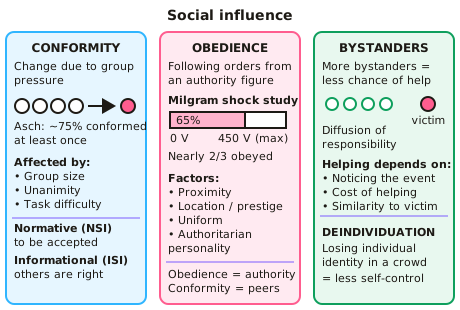
- Conformity is changing behaviour or opinion due to group pressure. Asch's line study found about 75% conformed at least once, with conformity affected by group size, unanimity and task difficulty.
- Normative social influence is conforming to be accepted; informational social influence is conforming because others are believed to be right.
- Obedience is following orders from an authority figure. In Milgram's study, 65% of participants continued to the maximum 450 volts.
- Factors affecting obedience include proximity of the authority figure, location/prestige, uniform and personality (the authoritarian personality).
- Bystander behaviour is affected by the number of bystanders (diffusion of responsibility), noticing the event, the cost of helping and similarity to the victim.
- Deindividuation describes losing a sense of individual identity in a crowd, which can lead to antisocial behaviour.
In more detail
- Asch (1951): participants conformed to an obviously wrong majority on about 37% of critical trials; 75% conformed at least once, and 25% never did.
- Milgram (1963): 65% of 40 men gave what they believed was the maximum 450-volt shock, and all went to at least 300 volts.
- Milgram's variations: obedience fell to 40% when the learner was in the same room, and 30% when the participant had to place the learner's hand on a shock plate.
- Uniform: Bickman (1974) found far more people obeyed a stranger dressed as a security guard than one in ordinary clothes.
- Personality: Adorno's authoritarian personality, measured with the F-scale, is linked to greater obedience.
Practice
Social influence: 10 questions
Pick an answer to check it, or open the answer for the explanation.
1. In Milgram's original study, what percentage of participants continued to 450 volts?
- 10%
- 35%
- 65%
- 100%
Show answer
C: 65%. Nearly two thirds obeyed to the maximum level.
2. What did Asch's line study investigate?
- Obedience
- Conformity to a majority
- Memory accuracy
- Bystander behaviour
Show answer
B: Conformity to a majority. Participants often gave obviously wrong answers to match the group.
3. What is normative social influence?
- Conforming because others are believed to be right
- Conforming to be liked and accepted by the group
- Obeying an authority figure
- Ignoring the group
Show answer
B: Conforming to be liked and accepted by the group. Informational influence is about believing others know better.
4. What is diffusion of responsibility?
- Everyone helping at once
- Individuals feeling less responsible to act when others are present
- Obeying orders
- Conforming to a minority
Show answer
B: Individuals feeling less responsible to act when others are present. It helps explain the bystander effect.
5. Which factor increases obedience?
- The authority figure being distant
- The authority figure wearing a uniform and being close by
- A low-prestige location
- Peers refusing to obey
Show answer
B: The authority figure wearing a uniform and being close by. Uniform and proximity both increase perceived legitimacy.
6. What did Milgram's study suggest about obedience?
- People rarely obey authority
- A majority of ordinary people will obey an authority figure even against their own conscience
- Obedience only occurs in unusual individuals
- Authority has no effect on behaviour
Show answer
B: A majority of ordinary people will obey an authority figure even against their own conscience. 65% of participants obeyed to the maximum voltage.
7. In Asch's line study, what proportion of participants conformed to the wrong answer at least once?
- About 75%
- About 100%
- About 25%
- About 50%
Show answer
A: About 75%. About 75% conformed at least once, even though the correct answer was obvious. This shows that group pressure can change behaviour.
8. A trainee copies colleagues' way of using a machine because she is unsure and assumes they know better. This is:
- Deindividuation
- Informational social influence
- Normative social influence
- Obedience to authority
Show answer
B: Informational social influence. She conforms because she believes the others are right, which is informational social influence. Normative influence is conforming to be accepted.
9. In a repeat of Asch's study, one confederate gives the correct answer. What is the likely effect on conformity?
- It falls, because unanimity is broken
- It rises, because the group is split
- It stays the same
- It rises, because the task seems harder
Show answer
A: It falls, because unanimity is broken. Conformity is higher when the majority is unanimous. One dissenter breaks unanimity and gives the participant support, so conformity drops.
10. Asch found that task difficulty affects conformity. When the lines were harder to judge, conformity:
- Decreased, as people felt more confident
- Vanished completely
- Stayed the same
- Increased, as people relied more on others
Show answer
D: Increased, as people relied more on others. When the task is difficult, people are less sure of their own answer and look to others, so conformity increases (informational influence).
Keep going in Full Marks
Full Marks has 33 questions on Social influence (23 more than here), set out in practice levels. You also get notes and 3D models for all 6 subtopics of Social context and behaviour, plus games, timed exams and past papers.