GCSE Geography · Topic 4
Urban issues and challenges
Urban issues and challenges is about the rapid growth of cities, and how to make urban life better and more sustainable.
We will study urbanisation and megacities, and the opportunities and challenges they bring.
Then we look at urban change in the U K, a U K city case study, regeneration, and sustainable urban living.
- 5 subtopics
- 179 questions
- Free: 4.1 notes and 6 questions
In this topic
- 4.1Urbanisation and megacitiesFree below · 55 questions
- 4.2Urban change and sustainabilityOpen in Full Marks · 49 questions
- 4.3UK city case study (London or Bristol): location, migration, opportunities and challengesOpen in Full Marks · 35 questions
- 4.4A city in an LIC or NEE: Rio de Janeiro case studyOpen in Full Marks · 21 questions
- 4.5Migration: push and pull factors, types of migration and its impactsOpen in Full Marks · 19 questions
4.1 · Free notes
Urbanisation and megacities
Key points
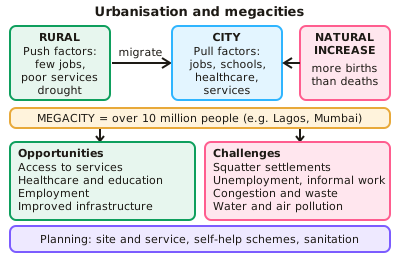
- Urbanisation is the increasing proportion of people living in towns and cities, driven by rural-urban migration (push and pull factors) and natural increase.
- A megacity has a population over 10 million; most rapid growth is now in LICs and NEEs.
- Opportunities in growing cities: access to services, healthcare, education, employment and improved infrastructure.
- Challenges: squatter settlements, unemployment and informal work, traffic congestion, waste disposal, water and air pollution, and pressure on services.
- Urban planning to improve life for the urban poor may include site and service schemes, self-help schemes and improved sanitation.
In more detail
- Megacities: Tokyo has about 37 million people, Delhi over 30 million and Lagos about 16 million, with the fastest growth now in Africa and Asia.
- Urban share: in 2007, for the first time, more than half the world lived in cities; the UN expects about 68% by 2050.
- Rio de Janeiro: about a fifth of people live in favelas such as Rocinha; the Favela Bairro project paved streets and added sanitation, lighting and services.
- Push and pull: push factors include rural poverty, drought and conflict; pull factors include jobs, healthcare, education and the hope of a better life.
- Natural increase: most migrants are young adults, so birth rates are high and cities also grow from within.
Practice
Urbanisation and megacities: 6 questions
Pick an answer to check it, or open the answer for the explanation.
1. What population threshold usually defines a megacity?
- 1 million
- 5 million
- 10 million
- 50 million
Show answer
C: 10 million. Megacities have over 10 million residents.
2. Which is a pull factor for rural-urban migration?
- Crop failure
- Better job opportunities and services in the city
- Drought
- Land shortage
Show answer
B: Better job opportunities and services in the city. Pull factors attract people to the destination.
3. What is a squatter settlement?
- Planned high-rise housing
- Unplanned informal housing built on land the occupants do not own
- Government housing
- A business district
Show answer
B: Unplanned informal housing built on land the occupants do not own. Services such as water and sanitation are often lacking.
4. Which is a challenge of rapid urban growth?
- Reduced traffic
- Pressure on services, waste disposal and pollution
- Lower population density
- Fewer informal jobs
Show answer
B: Pressure on services, waste disposal and pollution. Infrastructure often cannot keep pace with growth.
5. What is a self-help scheme?
- Government builds all housing
- Residents are given materials and support to improve their own homes
- Demolishing informal settlements
- Relocating residents to rural areas
Show answer
B: Residents are given materials and support to improve their own homes. It is usually cheaper and involves the community.
6. What is a push factor in rural-urban migration?
- Better healthcare in the city
- Lack of jobs or services in rural areas
- High wages in the city
- Better schools in the city
Show answer
B: Lack of jobs or services in rural areas. Push factors drive people away from their place of origin.
Keep going in Full Marks
Full Marks has 55 questions on Urbanisation and megacities (49 more than here), set out in practice levels. You also get notes and 3D models for all 5 subtopics of Urban issues and challenges, plus games, timed exams and past papers.