GCSE Geography · Topic 2
The living world
The living world is about ecosystems, how they work, and how people use and threaten them.
We will study global biomes, a small U K ecosystem, biodiversity and ecosystem services.
Then we look in depth at tropical rainforests and deforestation, hot deserts and desertification, and cold environments.
- 10 subtopics
- 436 questions
- Free: 2.1 notes and 10 questions
In this topic
- 2.1Ecosystems and tropical rainforestsFree below · 27 questions
- 2.2Hot deserts and cold environmentsOpen in Full Marks · 18 questions
- 2.3Global biomes: distribution, climate, soils and ecosystem interdependenceOpen in Full Marks · 77 questions
- 2.4A small-scale UK ecosystem (pond, woodland or similar)Open in Full Marks · 84 questions
- 2.5Biodiversity, ecosystem services and threats to ecosystemsOpen in Full Marks · 39 questions
- 2.6Tropical rainforest deforestation: causes, impacts and sustainable management case studyOpen in Full Marks · 41 questions
- 2.7Desertification and a hot desert development case study: opportunities, challenges and reduction strategiesOpen in Full Marks · 78 questions
- 2.8Coral reefs: distribution, characteristics, value, threats and sustainable managementOpen in Full Marks · 24 questions
- 2.9Polar environments: the Arctic and Antarctica, threats and sustainable managementOpen in Full Marks · 24 questions
- 2.10Deciduous woodlands: characteristics, nutrient cycling, threats and managementOpen in Full Marks · 24 questions
2.1 · Free notes
Ecosystems and tropical rainforests
Key points
- An ecosystem includes living (biotic) and non-living (abiotic) parts interacting; energy flows through food chains and food webs, and nutrients cycle between soil, biomass and litter.
- Biomes are large-scale ecosystems, their distribution controlled mainly by climate.
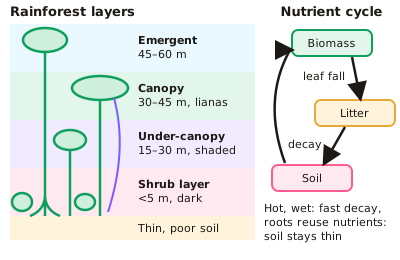
- Tropical rainforests have hot, wet conditions all year, a layered structure (emergent, canopy, under-canopy, shrub layer), and very high biodiversity.
- Plant adaptations include drip-tip leaves, buttress roots and lianas; nutrient cycling is rapid but soils are thin because nutrients are held in vegetation.
- Deforestation is driven by logging, mining, cattle ranching, commercial farming, road building and population growth.
- Sustainable management includes selective logging, replanting, conservation, ecotourism, international agreements and debt reduction schemes.
In more detail
- Nutrient cycle: most nutrients are stored in the vegetation, and heavy rain leaches them from the soil, so cleared land loses its fertility within a few years.
- Layers: emergent trees reach about 50 m, the canopy about 30 m, then the under-canopy and the shrub layer near the dark forest floor.
- Animal adaptations: sloths move slowly to save energy and have algae in their fur for camouflage; toucans' large beaks reach fruit on thin branches.
- Amazon facts: about 5.5 million km², home to roughly 10% of the world's known species.
- Medicines: the rosy periwinkle from Madagascar's rainforest gives drugs used to treat childhood leukaemia.
Practice
Ecosystems and tropical rainforests: 10 questions
Pick an answer to check it, or open the answer for the explanation.
1. Why is nutrient cycling fast in tropical rainforests?
- Cold temperatures
- Hot, wet conditions speed up decomposition
- Few plants grow
- Soils are very deep
Show answer
B: Hot, wet conditions speed up decomposition. Decomposers work rapidly in warm, humid conditions.
2. What mainly determines the distribution of biomes?
- Population density
- Climate
- Political borders
- Soil colour only
Show answer
B: Climate. Temperature and rainfall patterns are the key controls.
3. What are drip-tip leaves an adaptation to?
- Cold nights
- High rainfall, allowing water to run off quickly
- Strong winds
- Poor light
Show answer
B: High rainfall, allowing water to run off quickly. Water runs off, preventing damage and fungal growth.
4. Which is a cause of deforestation in the Amazon?
- Ecotourism
- Cattle ranching and commercial farming
- Selective logging only
- Replanting schemes
Show answer
B: Cattle ranching and commercial farming. Large areas are cleared for pasture and crops such as soya.
5. Which is a sustainable management strategy for rainforests?
- Clear felling
- Selective logging and replanting
- Building more roads
- Unregulated mining
Show answer
B: Selective logging and replanting. Only some trees are removed, allowing the forest to recover.
6. What is a food web?
- A single food chain
- A network of interconnected food chains in an ecosystem
- A type of biome
- A soil profile
Show answer
B: A network of interconnected food chains in an ecosystem. It shows how energy flows through many linked feeding relationships.
7. Which layer of a tropical rainforest is made up of the tallest trees, often over 40 m, that rise above the main canopy?
- Under-canopy layer
- Shrub layer
- Forest floor
- Emergent layer
Show answer
D: Emergent layer. Emergent trees poke above the closed canopy. They get full sunlight but are exposed to wind and heat. The shrub layer and forest floor are dark and low.
8. What is the main function of buttress roots in tropical rainforest trees?
- To store water for the dry season
- To absorb nutrients from deep in the soil
- To shed heavy rain from the leaves
- To support very tall trees in thin, shallow soils
Show answer
D: To support very tall trees in thin, shallow soils. Rainforest soils are thin, so tall trees have shallow roots. Wide, plank-like buttress roots spread the weight and stop the trees toppling over.
9. Which pair contains only biotic components of a rainforest ecosystem?
- Soil and humidity
- Sunlight and leaf litter
- Jaguar and strangler fig
- Rainfall and temperature
Show answer
C: Jaguar and strangler fig. Biotic means living. A jaguar and a fig tree are living organisms. Rainfall, temperature, sunlight, soil and humidity are abiotic (non-living).
10. Why do lianas grow as woody climbing plants in tropical rainforests?
- To store water in their stems for the dry season
- To protect themselves from grazing animals with spines
- To shed heavy rainfall quickly from their leaves
- To reach sunlight in the canopy without building thick trunks
Show answer
D: To reach sunlight in the canopy without building thick trunks. The forest floor is dark. Lianas climb tree trunks to reach light in the canopy, which saves the energy that tall self-supporting trunks would need.
Keep going in Full Marks
Full Marks has 27 questions on Ecosystems and tropical rainforests (17 more than here), set out in practice levels. You also get notes and 3D models for all 10 subtopics of The living world, plus games, timed exams and past papers.
On your exam board
- AQATopic 2: The living world
- OCR ATopic 3: UK environmental challenges, Topic 4: Ecosystems of the planet
- OCR BTopic 4: Sustaining ecosystems
- EdexcelTopic 3: Ecosystems, biodiversity and management
- CambridgeTopic 2.3: Coasts, Topic 2.5: Climate and natural vegetation, Topic 3.7: Environmental risks of economic development