GCSE Computer Science · Topic 13
Topic 3 Computer systems
Embedded systems and input and output devices are about the hidden computers inside everyday objects.
We will see how sensors, processors and actuators work together, and how to choose the right devices.
- 2 subtopics
- 47 questions
- Free: 13.1 notes and 10 questions
In this topic
- 13.1Embedded systems and input/output devicesFree below · 27 questions
- 13.2Automated systems, robotics and artificial intelligenceOpen in Full Marks · 20 questions
13.1 · Free notes
Embedded systems and input/output devices
Key points
- An embedded system is a computer system built into a larger device to perform one dedicated function (or a small set of them), for example in a washing machine, microwave, car engine management unit or digital watch.
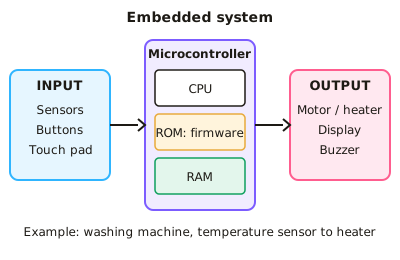
- Most embedded systems are built around a microcontroller: a single chip containing a CPU, ROM/flash, RAM and input/output interfaces.
- The program, called firmware, is stored in ROM or flash memory, which is non-volatile. It is not lost when the power is switched off, and the user usually cannot change it.
- Typical features: small size, low cost, low power consumption, reliable, and often real-time (it must respond within a fixed short time, e.g. a car airbag controller).
- Compared with a general-purpose computer (PC, laptop), an embedded system cannot run many different programs, has limited memory and processing power, and is hard to upgrade. In return it is cheap, efficient and dependable.
- Examples examiners accept: traffic lights, central heating thermostat, smart meter, fitness tracker, car ABS and engine management, alarm systems, digital cameras, Internet of Things (IoT) devices.
- The basic cycle is input → process → output. Sensors send data to the microcontroller, which runs the firmware and then controls outputs such as motors, heaters, lights or displays.
- Input devices send data into a computer: keyboard, mouse, touchscreen, microphone, scanner, barcode reader, webcam and sensors (temperature, light, pressure, motion/infrared, ultrasonic, moisture).
- Sensors usually produce analogue signals, so an analogue-to-digital converter (ADC) is needed before the CPU can process them. A digital-to-analogue converter (DAC) is used for analogue outputs such as a speaker.
- Output devices present or act on processed data: monitor/LCD, LED, speaker, buzzer, printer (laser, inkjet), 3D printer, and actuators such as motors, heaters and valves that cause physical movement or change.
- A capacitive touchscreen senses the electrical charge of a finger and supports multi-touch. A resistive screen senses pressure on layers and works with a gloved hand or stylus.
- Choose devices to fit the context in exam answers, e.g. a light sensor for automatic street lights, or a pressure sensor in a burglar alarm mat.
In more detail
- Worked washing machine: inputs: water level sensor, temperature sensor and buttons; processing: a microcontroller runs the chosen cycle; outputs: motor, heater, pump and display.
- Worked sensor choice: greenhouse → temperature and humidity sensors; parking aid → ultrasonic sensor; burglar alarm → passive infrared (PIR) motion sensor.
- Worked ADC: a temperature sensor gives 0–5 V, and an 8-bit ADC turns this into a number from 0 to 255.
- Embedded vs general purpose: a microwave's controller runs one program stored in firmware; a laptop runs many programs and you can install new ones.
Practice
Embedded systems and input/output devices: 10 questions
Pick an answer to check it, or open the answer for the explanation.
1. Which of these is an example of an embedded system?
- A file server in a school
- A laptop running a word processor
- A microcontroller controlling a microwave oven
- A desktop PC used for gaming
Show answer
C: A microcontroller controlling a microwave oven. An embedded system is built into a larger device to do a dedicated job. The microwave's controller does only that, unlike general-purpose PCs, laptops and servers.
2. Where is the firmware of an embedded system normally stored?
- In the CPU cache
- In RAM, so it can be changed quickly
- In virtual memory on a hard disk
- In ROM or flash memory, so it stays when power is off
Show answer
D: In ROM or flash memory, so it stays when power is off. Firmware must survive power loss, so it is held in non-volatile ROM or flash. RAM and cache are volatile and would lose the program.
3. Which is a typical characteristic of an embedded system compared with a general-purpose computer?
- It performs a dedicated task using limited resources
- It can run many different applications at once
- It always has a keyboard and monitor
- It needs a large hard disk
Show answer
A: It performs a dedicated task using limited resources. Embedded systems are designed for one specific function, with small memory, low power and low cost. They are not built to run varied software.
4. A washing machine uses a thermistor to measure water temperature. The thermistor is a…
- sensor, which is an input device
- storage device
- output device
- processor
Show answer
A: sensor, which is an input device. A thermistor is a temperature sensor. It sends data into the controller, so it is an input device.
5. Which component in a car is an actuator?
- A motor that locks the doors
- A parking distance sensor
- A light sensor for the headlights
- A microphone for hands-free calls
Show answer
A: A motor that locks the doors. An actuator is an output device that causes physical movement. The door-lock motor is controlled by the system, whereas the others are inputs.
6. Which statement about touchscreens is correct?
- Resistive screens cannot detect pressure
- Capacitive screens work with any plastic stylus
- Resistive screens need a conductive finger
- Capacitive screens detect a finger's electrical charge and allow multi-touch
Show answer
D: Capacitive screens detect a finger's electrical charge and allow multi-touch. Capacitive screens sense the charge from a conductive finger and handle multi-touch. Resistive screens respond to pressure, so stylus or gloves work.
7. A sensor in a data logger takes 4 readings per second. Each reading uses 2 bytes. How many bytes are stored in 1 hour?
- 28 800 bytes
- 7 200 bytes
- 57 600 bytes
- 14 400 bytes
Show answer
A: 28 800 bytes. 1 hour = 3600 s. 4 × 3600 = 14 400 readings. 14 400 × 2 bytes = 28 800 bytes.
8. Which sensor is most suitable for switching street lights on automatically at dusk?
- Pressure sensor
- Moisture sensor
- Light sensor
- Sound sensor
Show answer
C: Light sensor. A light sensor measures ambient brightness. The controller switches the lamps on when the reading falls below a set level.
9. Why is an analogue-to-digital converter (ADC) often needed in an embedded system?
- To increase the screen resolution
- To convert the analogue signals from sensors into digital data
- To make the CPU run faster
- To store firmware in ROM
Show answer
B: To convert the analogue signals from sensors into digital data. Sensors measure real-world quantities as analogue signals. The microcontroller only processes digital binary data, so an ADC converts them.
10. Which is a disadvantage of an embedded system?
- It uses far more power than a PC
- It is usually expensive to mass-produce
- It is hard to upgrade or change because the firmware is fixed
- It cannot be programmed at all
Show answer
C: It is hard to upgrade or change because the firmware is fixed. Firmware in ROM and the fixed hardware make upgrades difficult. Embedded systems are usually cheap and low-power, which are advantages.
Keep going in Full Marks
Full Marks has 27 questions on Embedded systems and input/output devices (17 more than here), set out in practice levels. You also get notes and 3D models for all 2 subtopics of Topic 3 Computer systems, plus games, timed exams and past papers.