GCSE Computer Science · Topic 4
Networks and cyber security
Networks and cyber security is about how computers communicate, and how we protect them.
We will compare LANs and WANs, network models and topologies, and the protocols that move data in packets.
Then we look at the threats to computer systems and the ways to defend against them.
- 2 subtopics
- 91 questions
- Free: 4.1 notes and 10 questions
In this topic
- 4.1Networks and protocolsFree below · 65 questions
- 4.2Cyber securityOpen in Full Marks · 26 questions
4.1 · Free notes
Networks and protocols
Key points
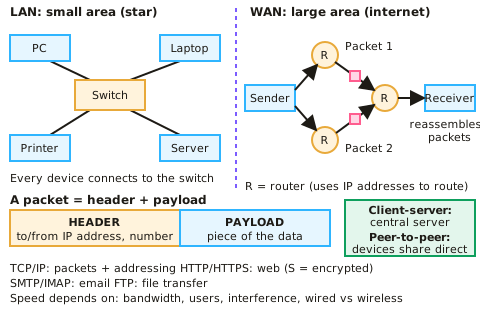
- A LAN covers a small geographic area (a home, school); a WAN covers a large area, such as the internet.
- Client-server networks use a central server; peer-to-peer networks share resources directly between devices.
- Topologies: a star topology connects every device to a central switch; a mesh topology connects devices to many others, giving redundancy.
- Protocols are rules for communication: TCP/IP (packet transmission and addressing), HTTP/HTTPS (web pages), SMTP/IMAP (email), FTP (file transfer).
- Data is split into packets with a header (addresses) and payload; packets can take different routes and are reassembled at the destination.
- Network performance is affected by bandwidth, number of users, interference and the transmission medium (wired is usually faster and more reliable than wireless).
In more detail
- Worked packets: a 1 MB file sent in packets of 1500 bytes needs about 670 packets, each with source and destination addresses and a sequence number for reassembly.
- Worked bandwidth: a 100 Mbps link can send a 50 MB file in about 50 × 8 ÷ 100 = 4 seconds, ignoring overheads.
- Worked protocols: HTTPS for secure web pages; SMTP to send email; IMAP to keep email synced on a server; FTP to transfer files.
- Star vs mesh: in a star, one cable failure affects only one device but a switch failure takes down the network; a mesh has many routes, so it is robust but expensive.
Practice
Networks and protocols: 10 questions
Pick an answer to check it, or open the answer for the explanation.
1. What is an IP address used for?
- Storing passwords
- Identifying a device on a network
- Speeding up the CPU
- Compressing data
Show answer
B: Identifying a device on a network. Packets are routed using IP addresses.
2. What is the difference between a LAN and a WAN?
- A LAN covers a small area; a WAN covers a large geographic area
- A WAN is always wireless
- A LAN has no switches
- They are the same
Show answer
A: A LAN covers a small area; a WAN covers a large geographic area. The internet is the largest WAN.
3. Which protocol is used for secure web pages?
- FTP
- SMTP
- HTTPS
- IMAP
Show answer
C: HTTPS. HTTPS encrypts data between browser and server.
4. What is in a packet header?
- Only the message content
- Addressing and sequencing information
- The whole file
- Nothing
Show answer
B: Addressing and sequencing information. This lets packets be routed and reassembled in order.
5. What is an advantage of a mesh topology?
- It uses the least cabling
- Multiple routes give redundancy if one link fails
- It needs no devices
- It is always wireless
Show answer
B: Multiple routes give redundancy if one link fails. There's no single point of failure.
6. What is the role of a router?
- To store files
- To direct data packets between networks
- To display web pages
- To encrypt passwords
Show answer
B: To direct data packets between networks. Routers use IP addresses to forward packets.
7. Which protocol is used to transfer email between servers?
- HTTP
- SMTP
- FTP
- TCP only
Show answer
B: SMTP. IMAP and POP are used to retrieve mail.
8. What is an advantage of a star topology?
- One failure stops the whole network
- If one cable fails, only that device is affected
- No central device needed
- It uses the least cabling
Show answer
B: If one cable fails, only that device is affected. The central switch is the main point of failure.
9. Which protocol lets a user read email stored on a mail server from several different devices?
- SMTP
- FTP
- IMAP
- HTTPS
Show answer
C: IMAP. IMAP keeps messages on the server so many devices can view them. SMTP is for sending email, and FTP is for file transfer.
10. A web designer uploads website files to a hosting company's server. Which protocol is designed for this?
- HTTP
- FTP
- SMTP
- IMAP
Show answer
B: FTP. FTP (File Transfer Protocol) is designed for moving files between computers. HTTP is mainly used to request web pages.
Keep going in Full Marks
Full Marks has 65 questions on Networks and protocols (55 more than here), set out in practice levels. You also get notes and 3D models for all 2 subtopics of Networks and cyber security, plus games, timed exams and past papers.