GCSE Chemistry · Topic 9
Chemistry of the atmosphere
Chemistry of the atmosphere tells the story of the air we breathe: how it formed, how it changed, and how humans are changing it now.
We will follow the Earth's atmosphere from volcanic gases to today's mixture of nitrogen and oxygen, and look at greenhouse gases and climate change.
Then we look at pollutants from burning fuels, and ways to reduce our carbon footprint.
- 4 subtopics
- 137 questions
- Free: 9.1 notes and 10 questions
In this topic
- 9.1The atmosphere and climate changeFree below · 23 questions
- 9.2Atmospheric pollutantsOpen in Full Marks · 19 questions
- 9.3Evolution of the Earth's atmosphereOpen in Full Marks · 27 questions
- 9.4Carbon footprint and reducing greenhouse gas emissionsOpen in Full Marks · 68 questions
9.1 · Free notes
The atmosphere and climate change
Key points
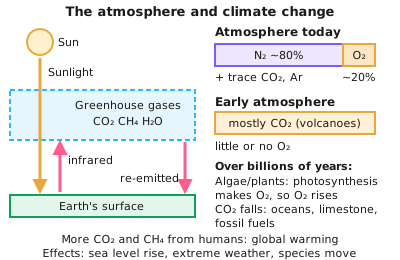
- The Earth's early atmosphere is thought to have been mostly carbon dioxide, released by volcanic activity, with little or no oxygen.
- Oxygen increased over billions of years due to photosynthesis by algae and plants; carbon dioxide decreased as it was locked in fossil fuels and rocks such as limestone, and dissolved in oceans.
- Today's atmosphere is approximately 80% nitrogen and 20% oxygen, with small amounts of other gases including carbon dioxide.
- Greenhouse gases (carbon dioxide, methane, water vapour) absorb infrared radiation, keeping Earth warm enough to support life; rising levels from human activity are linked to global warming.
- Potential effects of climate change include rising sea levels, more extreme weather, and changes to the distribution of species.
In more detail
- Uncertainty about the early atmosphere: there is little direct evidence from billions of years ago, so scientists use models and evidence from rocks and other planets.
- Evidence for climate change: rising global temperatures, shrinking ice sheets and glaciers, and rising sea levels, correlated with increasing CO₂ since the industrial revolution.
- Peer review: climate science is checked by many independent scientists, which increases confidence in the conclusions.
- Effects of climate change: sea level rise and flooding, more extreme weather, changes in rainfall and food production, and changes in where wildlife can live.
Practice
The atmosphere and climate change: 10 questions
Pick an answer to check it, or open the answer for the explanation.
1. What was the Earth's early atmosphere thought to be mostly made of?
- Oxygen
- Carbon dioxide
- Nitrogen
- Methane
Show answer
B: Carbon dioxide. Volcanic activity released large amounts of carbon dioxide.
2. What process increased oxygen levels in the atmosphere?
- Combustion
- Photosynthesis by algae and plants
- Respiration
- Volcanic activity
Show answer
B: Photosynthesis by algae and plants. Photosynthesising organisms released oxygen as a by-product over billions of years.
3. What is the approximate percentage of nitrogen in today's atmosphere?
- 20%
- 50%
- 80%
- 95%
Show answer
C: 80%. Nitrogen makes up around four-fifths of the atmosphere.
4. Which gases are described as greenhouse gases?
- Nitrogen and oxygen only
- Carbon dioxide, methane and water vapour
- Only carbon dioxide
- Noble gases
Show answer
B: Carbon dioxide, methane and water vapour. These gases trap infrared radiation, warming the atmosphere.
5. Which is a potential effect of climate change?
- Falling sea levels
- Rising sea levels and more extreme weather
- No change to wildlife
- Less carbon dioxide
Show answer
B: Rising sea levels and more extreme weather. Melting ice and thermal expansion of water raise sea levels.
6. What has been the main long-term trend in atmospheric carbon dioxide since the Industrial Revolution?
- A steady decrease
- A significant increase, largely from burning fossil fuels
- No change
- A decrease then a sudden rise
Show answer
B: A significant increase, largely from burning fossil fuels. Human activity has driven this rise.
7. Which process removed carbon dioxide from the early atmosphere?
- Dissolving in the oceans
- Escaping into space
- Reacting with nitrogen
- Being broken down by volcanoes
Show answer
A: Dissolving in the oceans. Carbon dioxide dissolved in the oceans. It was also used by algae and plants, and locked in rocks such as limestone. It did not escape into space.
8. Which gas from volcanoes condensed as the Earth cooled to form the oceans?
- Water vapour
- Methane
- Nitrogen
- Oxygen
Show answer
A: Water vapour. Volcanoes released large amounts of water vapour. As the Earth cooled, it condensed into liquid water that formed the oceans.
9. Dry air is about 20% oxygen by volume. What volume of oxygen is in 500 dm³ of dry air?
- 250 dm³
- 20 dm³
- 400 dm³
- 100 dm³
Show answer
D: 100 dm³. 20% of 500 dm³ = 0.20 × 500 = 100 dm³. 400 dm³ is roughly the volume of nitrogen (about 80%), not oxygen.
10. How did the formation of fossil fuels reduce carbon dioxide in the early atmosphere?
- It was burnt to leave solid carbon in rocks
- It reacted with the fossil fuels to form oxygen
- Plants and plankton absorbed it; their remains were buried
- Bacteria converted it into nitrogen gas
Show answer
C: Plants and plankton absorbed it; their remains were buried. Plants and plankton absorbed CO₂ by photosynthesis. When they died, their remains were buried and slowly formed coal, oil and gas, locking up the carbon.
Keep going in Full Marks
Full Marks has 23 questions on The atmosphere and climate change (13 more than here), set out in practice levels. You also get notes and 3D models for all 4 subtopics of Chemistry of the atmosphere, plus games, timed exams and past papers.