GCSE Chemistry · Topic 2
Bonding, structure and the properties of matter
Bonding, structure and the properties of matter explains why substances behave so differently: why salt has a high melting point, why metals bend and why oxygen is a gas.
We will look at ionic, covalent and metallic bonding, the structures they form, and how these explain properties like melting point and conductivity.
We also cover states of matter and the particle model, and nanoparticles with their special uses and risks.
- 4 subtopics
- 136 questions
- Free: 2.1 notes and 10 questions
In this topic
- 2.1Ionic, covalent and metallic bondingFree below · 21 questions
- 2.2Structures and properties of materialsOpen in Full Marks · 25 questions
- 2.3States of matter, the particle model and changes of stateOpen in Full Marks · 70 questions
- 2.4Nanoparticles: properties, uses and risksOpen in Full Marks · 20 questions
2.1 · Free notes
Ionic, covalent and metallic bonding
Key points
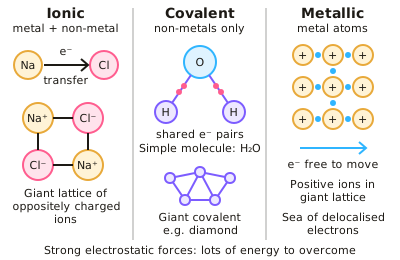
- Ionic bonding occurs between metals and non-metals: electrons are transferred, forming oppositely charged ions held in a giant lattice by strong electrostatic forces.
- Covalent bonding occurs between non-metals: atoms share pairs of electrons, forming simple molecules (e.g. water) or giant covalent structures (e.g. diamond).
- Metallic bonding: metal atoms form a giant lattice of positive ions surrounded by a 'sea' of delocalised electrons, free to move throughout the structure.
- All three bonding types involve strong electrostatic forces of attraction, requiring a lot of energy to overcome, though the resulting structures give very different properties.
In more detail
- Dot and cross for NaCl: sodium (2,8,1) transfers one electron to chlorine (2,8,7), giving Na⁺ [2,8] and Cl⁻ [2,8,8], drawn in square brackets with the charge outside.
- Formulae from charges: Mg²⁺ and Cl⁻ give MgCl₂; Al³⁺ and O²⁻ give Al₂O₃ (charges must cancel: 2 × 3+ = 6+, 3 × 2− = 6−).
- Covalent examples: H₂ (one shared pair), H₂O (two single bonds), O₂ (a double bond), N₂ (a triple bond), CH₄ (four single bonds).
- Limitations of diagrams: dot and cross diagrams do not show 3D shape; ball and stick models wrongly suggest big gaps between atoms.
Practice
Ionic, covalent and metallic bonding: 10 questions
Pick an answer to check it, or open the answer for the explanation.
1. What type of bonding occurs between a metal and a non-metal?
- Covalent
- Ionic
- Metallic
- No bonding
Show answer
B: Ionic. Metals and non-metals transfer electrons to form ions.
2. In covalent bonding, atoms:
- Transfer electrons completely
- Share pairs of electrons
- Lose all electrons
- Form a lattice of ions
Show answer
B: Share pairs of electrons. Shared pairs of electrons hold the atoms together.
3. What are the electrons in metallic bonding described as?
- Fixed in shells
- Delocalised and free to move
- Completely transferred
- Shared between two atoms only
Show answer
B: Delocalised and free to move. Delocalised electrons explain metals' conductivity and malleability.
4. Which is an example of a giant covalent structure?
- Sodium chloride
- Water
- Diamond
- Oxygen gas
Show answer
C: Diamond. Diamond's carbon atoms are held in a giant lattice by covalent bonds.
5. What holds ions together in an ionic lattice?
- Covalent bonds
- Strong electrostatic forces of attraction
- Weak intermolecular forces
- Delocalised electrons
Show answer
B: Strong electrostatic forces of attraction. Oppositely charged ions attract strongly in all directions.
6. What forms when a metal reacts with a non-metal?
- A covalent compound
- An ionic compound
- A metallic alloy
- A noble gas
Show answer
B: An ionic compound. Electrons transfer from metal to non-metal.
7. A sodium atom changes into a sodium ion, Na+. What happens to the atom?
- It loses one proton
- It gains one electron
- It loses one electron
- It gains one proton
Show answer
C: It loses one electron. Metals form positive ions by losing outer-shell electrons. Sodium loses its one outer electron, leaving 11 protons and 10 electrons, so the charge is +1. Protons never change.
8. What is the formula of magnesium chloride?
- Mg2Cl
- MgCl
- MgCl2
- Mg2Cl2
Show answer
C: MgCl2. Magnesium forms Mg2+ and chlorine forms Cl-. Two Cl- ions are needed to balance the charge on one Mg2+, so the formula is MgCl2.
9. What is the formula of potassium oxide, which contains K+ and O2- ions?
- KO
- KO2
- K2O
- K2O2
Show answer
C: K2O. Two K+ ions (total +2) balance one O2- ion (-2), so the formula is K2O. KO would not be electrically neutral.
10. How many electrons are in an aluminium ion, Al3+? (Aluminium has atomic number 13.)
- 3
- 16
- 10
- 13
Show answer
C: 10. An aluminium atom has 13 electrons. Forming Al3+ means losing 3 electrons, leaving 10. The number of protons stays at 13.
Keep going in Full Marks
Full Marks has 21 questions on Ionic, covalent and metallic bonding (11 more than here), set out in practice levels. You also get notes and 3D models for all 4 subtopics of Bonding, structure and the properties of matter, plus games, timed exams and past papers.
On your exam board
- AQATopic 2: Bonding, structure and the properties of matter
- OCR ATopic C1: Particles, Topic C2: Elements, compounds and mixtures
- OCR BTopic C1: Air and water, Topic C2: Chemical patterns, Topic C3: Chemicals of the natural environment, Topic C4: Material choices
- EdexcelTopic 1: Key concepts in chemistry, Topic 2: States of matter and mixtures, Topic 9: Separate chemistry 2
- CambridgeTopic 1: States of matter, Topic 2: Atoms, elements and compounds