GCSE Business · Topic 2
Business operations, marketing and finance
This topic gives an overview of the four main business functions, operations, human resources, marketing and finance.
We see how each one works, and how a decision in one function affects all of the others.
- 3 subtopics
- 132 questions
- Free: 2.1 notes and 10 questions
In this topic
- 2.1Operations and human resourcesFree below · 47 questions
- 2.2Marketing and financeOpen in Full Marks · 41 questions
- 2.3Interdependence of business functions: how operations, HR, marketing and finance decisions affect one another, plus case-study and exam skillsOpen in Full Marks · 44 questions
2.1 · Free notes
Operations and human resources
Key points
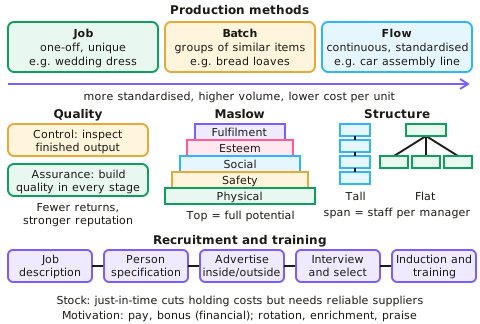
- Production methods: job (one-off, unique), batch (groups of similar items) and flow (continuous, standardised) production.
- Quality approaches include quality control (inspection) and quality assurance (building quality into every stage); benefits include fewer returns and stronger reputation.
- Procurement and stock control balance holding costs against the risk of running out; just-in-time minimises stock but relies on reliable suppliers.
- Recruitment may be internal or external, using job descriptions and person specifications; training can be induction, on-the-job or off-the-job.
- Motivation theories include Maslow's hierarchy and Herzberg; financial methods include pay, bonuses and commission, and non-financial methods include job rotation, enrichment and praise.
- Organisational structures may be tall or flat, with spans of control and chains of command affecting communication and decision-making.
In more detail
- Production methods by example: a wedding cake is job production, a batch of 200 loaves is batch production, and a plant filling cans nonstop is flow production.
- Worked labour productivity: 10 workers make 500 units a day → productivity = 500 ÷ 10 = 50 units per worker per day.
- Maslow's hierarchy: physiological → safety → love and belonging (social) → esteem → self-actualisation. Each level must be met before the next one motivates.
- Herzberg: hygiene factors (pay, conditions, job security) prevent dissatisfaction, but only motivators (recognition, responsibility, achievement) truly motivate.
Practice
Operations and human resources: 10 questions
Pick an answer to check it, or open the answer for the explanation.
1. Job production means:
- Making large batches
- Making one-off, unique items to order
- Continuous mass production
- Assembly line production
Show answer
B: Making one-off, unique items to order. Examples include a wedding dress or a bespoke building.
2. What is just-in-time stock control?
- Holding large buffer stocks
- Ordering stock to arrive only as it is needed, minimising storage costs
- Never ordering stock
- Buying in bulk only
Show answer
B: Ordering stock to arrive only as it is needed, minimising storage costs. It reduces costs but relies on dependable suppliers.
3. What is at the top of Maslow's hierarchy of needs?
- Safety
- Esteem
- Self-actualisation
- Physiological needs
Show answer
C: Self-actualisation. It represents reaching your full potential.
4. Which is a financial method of motivation?
- Job rotation
- Commission and bonuses
- Praise
- Job enrichment
Show answer
B: Commission and bonuses. Non-financial methods focus on the nature of the work itself.
5. What does a wide span of control mean?
- A manager supervises few people
- A manager supervises many people directly
- A tall structure
- A long chain of command
Show answer
B: A manager supervises many people directly. Flat structures typically have wider spans of control.
6. What does 'quality assurance' mean, compared with quality control?
- Checking finished products only
- Building quality checks into every stage of production, not just the final product
- Ignoring product quality
- Reducing production speed only
Show answer
B: Building quality checks into every stage of production, not just the final product. This tends to catch problems earlier and reduce waste.
7. A bakery bakes 300 identical rolls in one go, cleans the ovens, then bakes 300 sourdough loaves. Which production method is this?
- Cell production
- Flow production
- Batch production
- Job production
Show answer
C: Batch production. Batch production makes groups of similar items one batch at a time, then switches to the next product. Job production makes one-offs. Flow production runs continuously on a standardised line.
8. Which is the main advantage of flow production for a car-parts maker?
- Products can be changed quickly and cheaply
- It needs little capital investment
- Each item can be fully customised
- Low cost per unit from large-scale, standardised output
Show answer
D: Low cost per unit from large-scale, standardised output. Flow production is continuous and standardised, so high volumes spread fixed costs and give a low unit cost. The drawbacks are high set-up cost and low flexibility.
9. A firm stops relying on checking finished goods and builds quality checks into every stage. Which is the most likely benefit?
- Quality is checked only once, at the end
- Fewer staff need training
- Stock levels must increase
- Fewer defects and returns, helping its reputation
Show answer
D: Fewer defects and returns, helping its reputation. Quality assurance builds quality into every stage, so faults are prevented rather than found late. This means fewer defective items, fewer returns, less waste and a stronger reputation.
10. A pizza chain uses just-in-time ordering for its ingredients. What is its biggest risk?
- Ingredients going out of date in the stockroom
- A late supplier delivery stops production
- Cash tied up in large amounts of stock
- High storage costs for unused stock
Show answer
B: A late supplier delivery stops production. JIT keeps stock very low, so the firm depends on reliable suppliers. One late delivery can halt production. High storage costs, tied-up cash and waste are risks of holding large stock.
Keep going in Full Marks
Full Marks has 47 questions on Operations and human resources (37 more than here), set out in practice levels. You also get notes and 3D models for all 3 subtopics of Business operations, marketing and finance, plus games, timed exams and past papers.
On your exam board
- AQATopic 3: Business operations, Topic 5: Marketing, Topic I: Interdependence and exam skills
- OCRTopic 2: Marketing, Topic 3: People, Topic 7: The interdependent nature of business
- EdexcelTopic 1.4: Making the business effective, Topic 2.3: Making operational decisions, Topic I: Interdependence and exam skills
Not in the Cambridge specification.