GCSE Biology · Topic 2
Organisation
Organisation is all about how cells work together. Cells group into tissues, tissues into organs, and organs into whole systems that keep you alive.
In this topic we follow food through the digestive system, blood around the heart and vessels, air into the lungs, and water up through a plant.
We also look at diseases like coronary heart disease and cancer, how they are treated, and how diet and exercise affect your health.
- 9 subtopics
- 468 questions
- Free: 2.1 notes and 10 questions
In this topic
- 2.1Digestive system and enzymesFree below · 59 questions
- 2.2Heart, blood vessels and bloodOpen in Full Marks · 69 questions
- 2.3Non-communicable diseasesOpen in Full Marks · 68 questions
- 2.4Plant tissues and transportOpen in Full Marks · 29 questions
- 2.5Breathing system and gas exchange in the lungsOpen in Full Marks · 42 questions
- 2.6Treating cardiovascular disease: stents, statins, valves and transplantsOpen in Full Marks · 44 questions
- 2.7Diet, exercise and health: balanced diet, BMI and malnutritionOpen in Full Marks · 62 questions
- 2.8Transpiration and stomata: factors affecting water loss and the potometerOpen in Full Marks · 37 questions
- 2.9Cardiac output: heart rate, stroke volume and exerciseOpen in Full Marks · 58 questions
2.1 · Free notes
Digestive system and enzymes
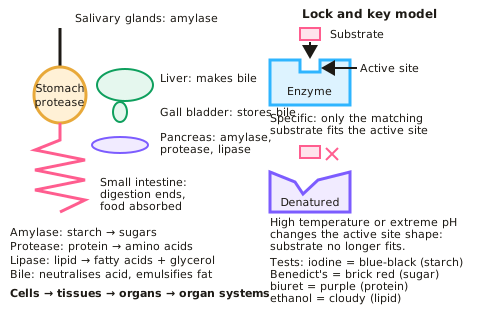
Key points
- Organisation: cells → tissues → organs → organ systems.
- Enzymes are biological catalysts. The active site fits a specific substrate (the lock and key model).
- High temperature or extreme pH changes the active site shape, so the enzyme is denatured.
- Amylase (carbohydrase) breaks starch into sugars; proteases break proteins into amino acids; lipases break lipids into fatty acids and glycerol.
- Bile, made in the liver and stored in the gall bladder, neutralises stomach acid and emulsifies fats to increase surface area.
- Food tests: iodine (starch, blue-black), Benedict's (sugars, brick red when heated), biuret (protein, purple), ethanol (lipids, cloudy).
In more detail
- Where each enzyme works: amylase is made in the salivary glands, pancreas and small intestine; protease in the stomach (pepsin), pancreas and small intestine; lipase in the pancreas and small intestine.
- Stomach acid: hydrochloric acid kills pathogens in food and gives the acidic pH that stomach proteases work best at. Bile is alkaline, so it neutralises the acid before food reaches the small intestine.
- Emulsifying fat breaks large fat droplets into many small ones. This gives a much larger surface area for lipase to act on, so fat is digested faster. Bile is not an enzyme.
- Enzyme graphs: rate rises with temperature up to an optimum (about 37 °C for human enzymes), then falls steeply as the active site changes shape. Each enzyme also has its own optimum pH.
Practice
Digestive system and enzymes: 10 questions
Pick an answer to check it, or open the answer for the explanation.
1. Which enzyme breaks down starch?
- Protease
- Lipase
- Amylase
- Bile
Show answer
C: Amylase. Amylase breaks starch into sugars.
2. What are the products of lipid digestion?
- Amino acids
- Fatty acids and glycerol
- Glucose
- Starch
Show answer
B: Fatty acids and glycerol. Lipases produce fatty acids and glycerol.
3. Why does an enzyme stop working at high temperature?
- It is used up
- The active site changes shape
- It reproduces
- The substrate gets bigger
Show answer
B: The active site changes shape. The enzyme is denatured and the substrate no longer fits.
4. Which reagent tests for protein?
- Iodine
- Benedict's
- Biuret
- Ethanol
Show answer
C: Biuret. Biuret turns purple when protein is present.
5. What does bile do?
- Digests protein
- Emulsifies fats and neutralises acid
- Makes amylase
- Absorbs water
Show answer
B: Emulsifies fats and neutralises acid. Emulsifying gives lipase a larger surface area to work on.
6. Where is bile produced?
- Stomach
- Liver
- Pancreas
- Small intestine
Show answer
B: Liver. It is then stored in the gall bladder before release into the small intestine.
7. What does the iodine test detect?
- Protein
- Sugar
- Starch
- Lipid
Show answer
C: Starch. Iodine solution turns blue-black in the presence of starch.
8. Which organ produces amylase and protease and releases them into the small intestine?
- Stomach
- Liver
- Gall bladder
- Pancreas
Show answer
D: Pancreas. The pancreas makes carbohydrase, protease and lipase and releases them into the small intestine. The liver only makes bile, which contains no enzymes.
9. Which sequence shows increasing levels of organisation in the body?
- Cell, tissue, organ, organ system
- Organ, tissue, cell, organ system
- Cell, organ, tissue, organ system
- Tissue, cell, organ system, organ
Show answer
A: Cell, tissue, organ, organ system. Similar cells form a tissue, tissues form an organ, and organs working together form an organ system.
10. A student mixes amylase and starch at 80 °C and finds no sugar. What is the best explanation?
- The substrate was used up
- Amylase only digests protein
- Starch was too concentrated
- The active site was denatured
Show answer
D: The active site was denatured. 80 °C changes the shape of the active site, so starch no longer fits and the enzyme is denatured. Amylase digests starch, not protein.
Keep going in Full Marks
Full Marks has 59 questions on Digestive system and enzymes (49 more than here), set out in practice levels. You also get notes and 3D models for all 9 subtopics of Organisation, plus games, timed exams and past papers.
On your exam board
- AQATopic 2: Organisation
- OCR ATopic B1: Cell level systems, Topic B2: Scaling up, Topic B6: Global challenges
- OCR BTopic B2: Keeping healthy, Topic B3: Living together – food and ecosystems, Topic B5: The human body – staying alive
- EdexcelTopic 1: Key concepts in biology, Topic 5: Health, disease and the development of medicines, Topic 6: Plant structures and their functions, Topic 8: Exchange and transport in animals
- CambridgeTopic 7: Human nutrition, Topic 8: Transport in plants, Topic 9: Transport in animals, Topic 11: Gas exchange in humans