A-level Psychology Year 13 · Topic 12
Stress
This topic looks at what stress does to the body, what causes it, how we can measure it, and how to manage it.
We will cover the SAM and HPA pathways, the General Adaptation Syndrome, and the links between stress, the immune system and heart disease.
Then we look at life changes, hassles and workplace stress, personality and gender differences, and drug, biofeedback and psychological treatments.
- 8 subtopics
- 272 questions
- Free: 12.1 notes and 10 questions
In this topic
- 12.1The physiology of stress: sympathomedullary pathway, HPA axis and General Adaptation SyndromeFree below · 42 questions
- 12.2Stress-related illness: the immune system and cardiovascular disordersOpen in Full Marks · 29 questions
- 12.3Sources of stress: life changes and daily hasslesOpen in Full Marks · 38 questions
- 12.4Workplace stress: workload and control (Marmot)Open in Full Marks · 32 questions
- 12.5Measuring stress: self-report (SRRS, hassles scale) and physiological measuresOpen in Full Marks · 25 questions
- 12.6Individual differences in stress: Type A/B/C personality, hardiness and gender differencesOpen in Full Marks · 39 questions
- 12.7Managing stress: drug therapy (benzodiazepines, beta-blockers) and biofeedbackOpen in Full Marks · 34 questions
- 12.8Managing stress: stress inoculation training, hardiness training, social support and gender differences in copingOpen in Full Marks · 33 questions
12.1 · Free notes
The physiology of stress: sympathomedullary pathway, HPA axis and General Adaptation Syndrome
Key points
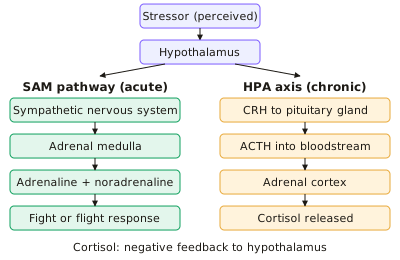
- Stress is the body's physiological response to a perceived threat (a stressor). The hypothalamus coordinates the response through two routes: the sympathomedullary pathway (SAM) for acute stress and the hypothalamic-pituitary-adrenal (HPA) axis for chronic stress.
- SAM pathway: the hypothalamus activates the sympathetic nervous system, which stimulates the adrenal medulla to release adrenaline (and noradrenaline) into the bloodstream.
- Adrenaline produces the fight or flight response: heart rate, blood pressure and breathing rate rise, glucose is released for energy, digestion is inhibited and pupils dilate.
- When the threat passes, the parasympathetic nervous system restores homeostasis by slowing the heart rate and breathing. It acts as the 'brake' after sympathetic arousal.
- HPA axis sequence: the hypothalamus releases corticotropin-releasing hormone (CRH), which acts on the pituitary gland. The pituitary releases adrenocorticotropic hormone (ACTH) into the blood, which stimulates the adrenal cortex to release cortisol.
- Cortisol raises blood glucose for energy and aids tissue repair in the short term. It also suppresses the immune system, so prolonged high levels are harmful. Negative feedback (high cortisol reduces CRH and ACTH release) normally switches the axis off.
- Exam tip: the adrenal medulla (inner part) releases adrenaline quickly via the SAM pathway. The adrenal cortex (outer part) releases cortisol more slowly via the HPA axis.
- General Adaptation Syndrome (GAS) (Selye, 1936) describes the response to any prolonged stressor in three stages. Selye saw the response as non-specific (the same whatever the stressor).
- Stage 1, alarm reaction: the body perceives the threat. There is initial shock (resistance falls) then countershock, with the SAM pathway active, adrenaline released and fight or flight under way. Stage 2, resistance: the body adapts and appears to cope, but cortisol stays raised and resources are being used up.
- Stage 3, exhaustion: if the stressor continues, physiological resources are depleted. The person becomes vulnerable to stress-related illness (e.g. infection, cardiovascular disorders).
- Evaluation: Selye's evidence came mainly from rats subjected to stressors, so generalisation to humans is limited. The GAS also ignores psychological factors (appraisal, individual differences), and the research raises ethical issues. A strength is that it linked chronic stress to illness and prompted further research.
- Evaluation: the SAM and HPA systems often operate together, so the acute/chronic distinction is a simplification. The 'fight or flight' model may also show gender bias (beta bias), since much early research used male animals and Taylor proposed a tend and befriend response in females.
In more detail
- Worked SAM vs HPA: a car swerves towards you → your heart pounds within seconds (SAM, adrenaline). A month of exam pressure → raised cortisol over weeks (HPA).
- Negative feedback: high cortisol tells the hypothalamus and pituitary to reduce CRH and ACTH, switching the HPA response off; chronic stress can disrupt this control.
- Selye's observation: rats exposed to very different stressors (cold, injections, exercise) showed the same pattern: enlarged adrenal glands, shrunken immune tissue and stomach ulcers.
- Mason's criticism: Mason (1975) argued the response is not identical for every stressor, because psychological factors such as perceived control change hormone levels.
Practice
The physiology of stress: sympathomedullary pathway, HPA axis and General Adaptation Syndrome: 10 questions
Pick an answer to check it, or open the answer for the explanation.
1. Which hormone is released by the adrenal medulla during the sympathomedullary response to acute stress?
- Cortisol
- Adrenaline
- ACTH
- CRH
Show answer
B: Adrenaline. The sympathetic nervous system stimulates the adrenal medulla to release adrenaline (and noradrenaline). Cortisol comes from the adrenal cortex, ACTH from the pituitary and CRH from the hypothalamus.
2. In the HPA axis, which structure releases ACTH into the bloodstream?
- Adrenal cortex
- Hypothalamus
- Pituitary gland
- Adrenal medulla
Show answer
C: Pituitary gland. CRH from the hypothalamus stimulates the pituitary gland to release ACTH. ACTH then acts on the adrenal cortex, which releases cortisol.
3. Which shows the correct order of the HPA axis?
- Hypothalamus → adrenal medulla → pituitary → cortisol
- Adrenal cortex → pituitary → hypothalamus → cortisol
- Hypothalamus → pituitary → adrenal cortex → cortisol
- Pituitary → hypothalamus → adrenal medulla → adrenaline
Show answer
C: Hypothalamus → pituitary → adrenal cortex → cortisol. The hypothalamus (CRH) stimulates the pituitary (ACTH), which stimulates the adrenal cortex to release cortisol. The adrenal medulla belongs to the SAM pathway.
4. A cyclist swerves to avoid a car and feels their heart pounding within seconds. Which system is mainly responsible for this immediate response?
- HPA axis
- Sympathomedullary pathway
- Resistance stage of the GAS
- Parasympathetic nervous system
Show answer
B: Sympathomedullary pathway. Acute, immediate arousal is due to the sympathomedullary pathway: sympathetic activation and adrenaline release from the adrenal medulla. The HPA axis is slower and linked to chronic stress.
5. After weeks of exam pressure, Tom copes well and his heart rate is near normal, but his cortisol remains raised. Which GAS stage is he in?
- Resistance
- Shock phase
- Alarm reaction
- Exhaustion
Show answer
A: Resistance. In resistance the body appears to cope and arousal is lower than in alarm, but cortisol stays elevated and resources are gradually being used. Exhaustion would involve depleted resources and illness.
6. Which statement about cortisol is correct?
- It speeds up digestion during stress
- It is released by the pituitary gland
- It is released by the adrenal medulla within seconds
- It raises blood glucose and suppresses the immune system
Show answer
D: It raises blood glucose and suppresses the immune system. Cortisol, released by the adrenal cortex, increases blood glucose for energy and suppresses immune function. The pituitary releases ACTH, and digestion is inhibited in stress.
7. What is the main role of the parasympathetic nervous system after a stressor has passed?
- Trigger release of CRH
- Return the body to its resting state
- Increase heart rate to maintain arousal
- Release adrenaline from the adrenal medulla
Show answer
B: Return the body to its resting state. The parasympathetic branch restores homeostasis by slowing heart rate and breathing. Adrenaline release and raised heart rate are sympathetic effects.
8. Which is a valid criticism of Selye's research into the General Adaptation Syndrome?
- It only studied short-term acute stress
- It found stress responses are specific to each stressor
- It only studied psychological responses
- It was based mainly on rats, so may not generalise to humans
Show answer
D: It was based mainly on rats, so may not generalise to humans. Selye's work used rats, so generalising to humans is questionable, and it ignored psychological factors. He actually proposed a non-specific response to prolonged stressors.
9. Mean morning cortisol was 400 nmol/L in a control group and 560 nmol/L in a stressed group. What is the percentage increase in the stressed group?
- 28.6%
- 40%
- 160%
- 56%
Show answer
B: 40%. Increase = 560 − 400 = 160 nmol/L. 160 ÷ 400 × 100 = 40%. 28.6% wrongly divides by 560, and 160% is the raw difference.
10. Which is a physiological effect of sympathetic activation during fight or flight?
- Increased heart rate and inhibited digestion
- Decreased blood pressure and increased digestion
- Constricted pupils and slowed breathing
- Release of cortisol from the adrenal medulla
Show answer
A: Increased heart rate and inhibited digestion. Sympathetic arousal increases heart rate and blood pressure and inhibits digestion. Cortisol comes from the adrenal cortex, not the medulla.
Keep going in Full Marks
Full Marks has 42 questions on The physiology of stress: sympathomedullary pathway, HPA axis and General Adaptation Syndrome (32 more than here), set out in practice levels. You also get notes and 3D models for all 8 subtopics of Stress, plus games, timed exams and past papers.
On your exam board
- AQATopic 7: Stress
- CambridgeTopic 9: Health psychology
Not in the OCR and Edexcel specifications.