A-level Physics Year 13 · Topic 31
Magnetic forces and fields
Magnetic forces and fields is about how magnetic fields push on currents and moving charges.
We will draw field patterns around wires and solenoids, and use Fleming's left-hand rule and F equals B I l.
Then we follow charges moving in circles, explain the Hall effect, and measure magnetic flux density with a current balance.
- 5 subtopics
- 279 questions
- Free: 31.1 notes and 10 questions
In this topic
- 31.1Magnetic field patterns: wires, coils, solenoids; Fleming's left-hand ruleFree below · 73 questions
- 31.2Magnetic flux density and force on a current-carrying conductor (F = BIl)Open in Full Marks · 62 questions
- 31.3Force on a moving charge (F = Bqv) and circular paths in magnetic fieldsOpen in Full Marks · 67 questions
- 31.4Hall effect and the Hall probeOpen in Full Marks · 20 questions
- 31.5Practical: measuring magnetic flux density with a current balanceOpen in Full Marks · 57 questions
31.1 · Free notes
Magnetic field patterns: wires, coils, solenoids; Fleming's left-hand rule
Key points
- A magnetic field is a region where a magnet, moving charge or current-carrying conductor experiences a force. Field lines show the direction a free north pole would move, so outside a magnet they run from N to S.
- The closer the field lines, the stronger the field. Field lines never cross and form closed loops, running S to N inside the magnet.
- A uniform field has parallel, equally spaced straight lines, e.g. between two flat, opposite poles close together. On diagrams, dots mean out of the page and crosses mean into the page.
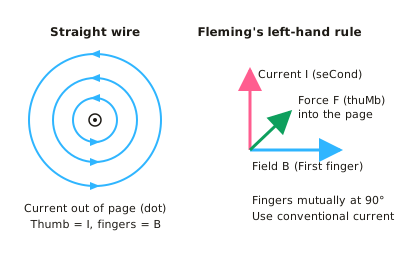
- Around a long straight wire the field lines are concentric circles centred on the wire, in planes perpendicular to it. They get further apart with distance, showing the field weakens.
- Right-hand grip rule: thumb along the conventional current, fingers curl in the direction of the field. Reversing the current reverses the field, so a plotting compass turns through 180°.
- A flat circular coil gives circular field lines close to the wire. At the centre the field is straight and perpendicular to the plane of the coil, like a short bar magnet.
- A solenoid has a strong uniform field inside (parallel lines along the axis) and a bar-magnet pattern outside. Viewed from one end, clockwise current gives a south pole and anticlockwise gives a north pole.
- Solenoid field strength increases with more current, more turns per metre and a soft-iron core. Reversing the current reverses the field direction but not its strength.
- Fleming's left-hand rule (motor effect): First finger = Field, seCond finger = Conventional current (+ to –), thuMb = Motion (force). The three are mutually at 90°.
- The force on a current-carrying wire is zero when the current is parallel to the field and a maximum when perpendicular. It is always perpendicular to both. Parallel wires with currents in the same direction attract, and opposite currents repel.
In more detail
- Solenoid poles: look at one end; if the current flows anticlockwise that end is a north pole, if clockwise it is a south pole.
- Worked Fleming's rule: field pointing north and current flowing east along a horizontal wire → the force on the wire is vertically upwards.
- Parallel wires: currents in the same direction attract and in opposite directions repel; this was used to define the ampere.
- Stronger electromagnets: more current, more turns per metre, and a soft iron core that concentrates the field lines.
Practice
Magnetic field patterns: wires, coils, solenoids; Fleming's left-hand rule: 10 questions
Pick an answer to check it, or open the answer for the explanation.
1. Outside a bar magnet, magnetic field lines are drawn:
- from the south pole to the north pole
- parallel to the magnet's axis only
- from the north pole to the south pole
- as closed loops that never leave the magnet
Show answer
C: from the north pole to the south pole. By convention, field lines show the direction of the force on an isolated north pole. Outside the magnet they therefore run from N to S, and they continue from S to N inside.
2. A plotting compass is near a vertical wire whose field dominates Earth's. When the current is reversed, the needle:
- oscillates, then settles in the same direction
- does not move
- turns through 90°
- turns through 180°
Show answer
D: turns through 180°. Reversing the current reverses the field direction around the wire. The compass needle lines up with the field, so it turns through 180°.
3. Conventional current flows vertically upwards in a straight wire. Viewed from above, the field lines around the wire go:
- clockwise
- anticlockwise
- radially outwards
- vertically upwards
Show answer
B: anticlockwise. Right-hand grip rule: thumb up (along the current), fingers curl anticlockwise when viewed from above. The field forms circles around the wire.
4. A horizontal wire carries current due north in a horizontal field pointing due east. Fleming's left-hand rule gives the force:
- vertically downwards
- vertically upwards
- due south
- due west
Show answer
A: vertically downwards. First finger points east (field), second finger north (current). The thumb then points vertically downwards, perpendicular to both.
5. In Fleming's left-hand rule, the thumb, first finger and second finger represent respectively:
- current, field, force
- force, current, field
- force, field, current
- field, current, force
Show answer
C: force, field, current. Thumb = motion (force), First finger = Field, seCond finger = Current. The three are mutually perpendicular.
6. Which change would NOT alter the strength of the magnetic field inside a long solenoid?
- doubling the current
- doubling the turns per metre
- reversing the current direction
- inserting a soft-iron core
Show answer
C: reversing the current direction. Reversing the current reverses the field direction but leaves its magnitude unchanged. The other three each increase the flux density.
7. Looking at one end of a solenoid, the conventional current flows clockwise. That end behaves as:
- a north pole only if it has an iron core
- a neutral point
- a south pole
- a north pole
Show answer
C: a south pole. Clockwise current seen from an end gives a south pole (anticlockwise gives a north pole). An iron core only strengthens the field.
8. Which statement describes a uniform magnetic field?
- field lines are parallel and equally spaced
- field lines are circles around a wire
- field lines get closer together towards the centre
- field lines radiate outwards from a point
Show answer
A: field lines are parallel and equally spaced. A uniform field has the same strength and direction everywhere. This is shown by straight, parallel, equally spaced lines, e.g. between flat opposite poles.
9. Two long parallel wires carry currents in the same direction. The wires:
- repel each other
- attract each other
- attract only if the currents are equal
- exert no force on each other
Show answer
B: attract each other. Each wire lies in the other's field. Fleming's left-hand rule gives a force towards the other wire, so parallel currents attract and opposite currents repel.
10. A straight wire carrying current lies parallel to a uniform magnetic field. The magnetic force on the wire is:
- maximum
- directed along the wire
- zero
- equal to BIl sin 45°
Show answer
C: zero. F = BIl sin θ with θ = 0° gives F = 0. There is no force when the current is parallel to the field.
Keep going in Full Marks
Full Marks has 73 questions on Magnetic field patterns: wires, coils, solenoids; Fleming's left-hand rule (63 more than here), set out in practice levels. You also get notes and 3D models for all 5 subtopics of Magnetic forces and fields, plus games, timed exams and past papers.