A-level Physics Year 13 · Topic 29
Electric field strength and potential
Electric field strength and potential describes the forces between charges and the energy they store.
We will use Coulomb's law, radial fields and uniform fields between parallel plates.
Then we study electric potential and potential gradient, compare electric and gravitational fields, and follow charged particles through fields.
- 5 subtopics
- 293 questions
- Free: 29.1 notes and 10 questions
In this topic
- 29.1Coulomb's law and radial electric field strengthFree below · 58 questions
- 29.2Uniform electric fields between parallel plates and field patternsOpen in Full Marks · 62 questions
- 29.3Electric potential and electric potential energyOpen in Full Marks · 55 questions
- 29.4Potential gradient; comparing gravitational and electric fieldsOpen in Full Marks · 61 questions
- 29.5Motion of charged particles in uniform electric fieldsOpen in Full Marks · 57 questions
29.1 · Free notes
Coulomb's law and radial electric field strength
Key points
- Coulomb's law: the force between two point charges is F = Q₁Q₂/(4πε₀r²), acting along the line joining them. Here ε₀ = 8.85×10⁻¹² F m⁻¹, so 1/(4πε₀) ≈ 8.99×10⁹ N m² C⁻².
- The force obeys an inverse square law: doubling r quarters F. Like charges repel and unlike charges attract, and the two forces are equal and opposite (Newton's third law).
- Electric field strength E is the force per unit positive charge, E = F/Q. It is a vector that points in the direction a positive test charge would be pushed. The unit is N C⁻¹, which is equivalent to V m⁻¹.
- The test charge must be small and positive so that it does not disturb the charge distribution that produces the field.
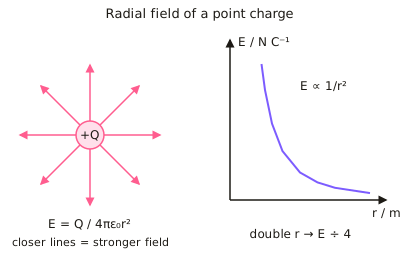
- For a point charge, E = Q/(4πε₀r²). A charged sphere acts as if all its charge were at its centre (for r ≥ radius), and r is measured from that centre.
- A point-charge field is radial: outward from +Q and inward towards −Q. E ∝ 1/r², so E against r is a steeply falling curve. E against 1/r² is a straight line through the origin with gradient Q/(4πε₀).
- The force on a charge q in a field is F = qE. A positive charge moves along E and a negative charge (e.g. an electron) moves opposite to E.
- Fields from several charges combine by vector superposition. A neutral point is where the resultant E = 0. It lies between two like charges, and outside two unlike charges on the side of the smaller charge.
- Compare with gravity: both are inverse square laws, but gravity is always attractive, whereas electric forces can attract or repel. The electric force between a proton and an electron is about 10³⁹ times the gravitational force.
- Exam technique: convert cm, nC and μC to SI units, square r, and give a direction as well as a magnitude for E. Remember that the force on an electron is opposite to E.
In more detail
- Worked Coulomb's law: two +2.0 μC charges 0.10 m apart → F = 8.99 × 10⁹ × (2.0 × 10⁻⁶)² ÷ 0.10² = 3.6 N, repulsive.
- Worked field: a +5.0 nC charge at 0.20 m → E = 8.99 × 10⁹ × 5.0 × 10⁻⁹ ÷ 0.20² = 1.1 × 10³ N C⁻¹, pointing away from the charge.
- Worked comparison: in hydrogen (r = 5.3 × 10⁻¹¹ m) the electric force is 8.2 × 10⁻⁸ N and the gravitational force 3.6 × 10⁻⁴⁷ N, about 10³⁹ times weaker.
- Worked neutral point: +4Q and +Q are 0.30 m apart; E = 0 where 4/x² = 1/(0.30 − x)² → x = 0.20 m from the 4Q charge.
Practice
Coulomb's law and radial electric field strength: 10 questions
Pick an answer to check it, or open the answer for the explanation.
1. Point charges +2.0 nC and −3.0 nC are 5.0 cm apart in air. What is the force between them? (1/4πε₀ = 8.99×10⁹ N m² C⁻²)
- 5.4×10⁻⁸ N, attractive
- 2.2×10⁻⁵ N, repulsive
- 2.2×10⁻⁵ N, attractive
- 8.6×10⁻⁵ N, attractive
Show answer
C: 2.2×10⁻⁵ N, attractive. F = kQ₁Q₂/r² = 8.99×10⁹ × 6.0×10⁻¹⁸ / (0.050)² = 2.2×10⁻⁵ N. The charges are opposite, so the force is attractive.
2. The separation of two point charges is tripled. The force between them becomes:
- 9 times the original
- 3 times the original
- 1/3 of the original
- 1/9 of the original
Show answer
D: 1/9 of the original. Coulomb's law gives F ∝ 1/r². Tripling r divides F by 3² = 9.
3. What is the electric field strength 0.30 m from a point charge of +4.0 μC in air? (1/4πε₀ = 8.99×10⁹ N m² C⁻²)
- 4.0×10⁵ N C⁻¹ directed away from the charge
- 4.0×10⁵ N C⁻¹ directed towards the charge
- 1.2×10⁵ N C⁻¹ directed away from the charge
- 3.6×10⁴ N C⁻¹ directed away from the charge
Show answer
A: 4.0×10⁵ N C⁻¹ directed away from the charge. E = kQ/r² = 8.99×10⁹ × 4.0×10⁻⁶ / 0.30² ≈ 4.0×10⁵ N C⁻¹. A positive source gives a field pointing away from it.
4. Which is the correct definition of electric field strength at a point?
- Force per unit mass
- Charge per unit area
- Work done per unit charge from infinity
- Force per unit positive charge
Show answer
D: Force per unit positive charge. E = F/Q is the force acting per unit positive charge placed at that point. Work per unit charge from infinity is potential.
5. A conducting sphere of radius 0.10 m carries +5.0 nC. What is E at 0.30 m from its centre? (1/4πε₀ = 8.99×10⁹ N m² C⁻²)
- 1.5×10² N C⁻¹
- 1.1×10³ N C⁻¹
- 5.0×10² N C⁻¹
- 4.5×10³ N C⁻¹
Show answer
C: 5.0×10² N C⁻¹. Outside a sphere the charge acts as if at its centre, so r = 0.30 m. E = 8.99×10⁹ × 5.0×10⁻⁹ / 0.30² ≈ 5.0×10² N C⁻¹.
6. Point charges +Q and +4Q are a distance d apart. At what distance from +Q, along the line joining them, is the resultant field zero?
- 2d/3
- d/3
- d/2
- d/5
Show answer
B: d/3. Set Q/x² = 4Q/(d−x)². Then d−x = 2x, so x = d/3 from +Q. The fields cancel only between like charges.
7. Which statement correctly compares electric and gravitational forces between point objects?
- Both follow inverse square laws, but only the electric force can repel
- Electric force depends on r but gravitational force does not
- Gravitational force is far stronger for fundamental particles
- Both are always attractive
Show answer
A: Both follow inverse square laws, but only the electric force can repel. Both vary as 1/r². Mass has only one sign, so gravity always attracts, but charge has two signs, so electric forces can attract or repel.
8. In a hydrogen atom the electron is 5.3×10⁻¹¹ m from the proton. What is the electrostatic force between them? (e = 1.60×10⁻¹⁹ C)
- 2.3×10⁻²⁸ N
- 4.3×10⁻¹⁸ N
- 1.6×10⁻⁷ N
- 8.2×10⁻⁸ N
Show answer
D: 8.2×10⁻⁸ N. F = 8.99×10⁹ × (1.60×10⁻¹⁹)² / (5.3×10⁻¹¹)² ≈ 8.2×10⁻⁸ N. Forgetting to square r gives 4.3×10⁻¹⁸ N.
9. An electron is placed in a field of 2.0×10⁴ N C⁻¹. What is the force on it? (e = 1.60×10⁻¹⁹ C)
- 3.2×10⁻¹⁵ N in the same direction as the field
- 8.0×10⁻²⁴ N opposite to the field
- 1.3×10²³ N opposite to the field
- 3.2×10⁻¹⁵ N opposite to the field
Show answer
D: 3.2×10⁻¹⁵ N opposite to the field. F = eE = 1.60×10⁻¹⁹ × 2.0×10⁴ = 3.2×10⁻¹⁵ N. The electron is negative, so the force is opposite to the field.
10. Point P is midway between +2.0 μC and −2.0 μC charges 0.40 m apart. What is the field at P? (1/4πε₀ = 8.99×10⁹ N m² C⁻²)
- 4.5×10⁵ N C⁻¹ towards the negative charge
- Zero
- 9.0×10⁵ N C⁻¹ towards the negative charge
- 9.0×10⁵ N C⁻¹ towards the positive charge
Show answer
C: 9.0×10⁵ N C⁻¹ towards the negative charge. Each charge gives 8.99×10⁹ × 2.0×10⁻⁶ / 0.20² = 4.5×10⁵ N C⁻¹. Both fields point towards the negative charge, so they add to 9.0×10⁵ N C⁻¹.
Keep going in Full Marks
Full Marks has 58 questions on Coulomb's law and radial electric field strength (48 more than here), set out in practice levels. You also get notes and 3D models for all 5 subtopics of Electric field strength and potential, plus games, timed exams and past papers.