A-level Geography Year 13 · Topic 15
Climate change futures
Climate change futures looks at how the climate has changed in the past, and how it might change in the future.
We will study natural climate change, the evidence for it, and the human causes of recent warming.
Then we examine the impacts of climate change, future projections, and how the world can mitigate and adapt.
- 7 subtopics
- 422 questions
- Free: 15.1 notes and 10 questions
In this topic
- 15.1Natural climate change: Quaternary and Holocene variations, orbital, solar and volcanic forcingFree below · 77 questions
- 15.2Evidence for climate change: ice cores, sediments, tree rings and instrumental recordsOpen in Full Marks · 66 questions
- 15.3Human causes: enhanced greenhouse effect, radiative forcing and climate feedbacksOpen in Full Marks · 70 questions
- 15.4Impacts of climate change on ecosystems, sea level, water, food and human healthOpen in Full Marks · 79 questions
- 15.5Climate projections: models, IPCC scenarios, uncertainty and riskOpen in Full Marks · 66 questions
- 15.6Mitigation: emissions reduction, carbon trading, renewables and geoengineeringOpen in Full Marks · 34 questions
- 15.7Adaptation and international agreements: UNFCCC, Paris Agreement and resilienceOpen in Full Marks · 30 questions
15.1 · Free notes
Natural climate change: Quaternary and Holocene variations, orbital, solar and volcanic forcing
Key points
- The Quaternary (last 2.58 million years) is the period of repeated glacial–interglacial cycles. The Holocene (last ~11,700 years) is the current interglacial, with relatively stable climate.
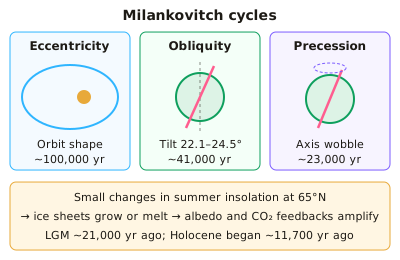
- Milankovitch cycles are regular changes in Earth's orbit that alter the seasonal and latitudinal distribution of insolation, not the total annual energy received. They are the pacemaker of the ice ages.
- Eccentricity is the change in orbit shape from near-circular to elliptical, with a period of ~100,000 years (also ~400,000 years). It has the smallest direct effect on insolation but matches the dominant glacial cycle of the last ~800,000 years.
- Obliquity is the axial tilt, which varies between ~22.1° and 24.5° over ~41,000 years (currently 23.4°). A greater tilt gives stronger seasons and more summer insolation at high latitudes.
- Precession is the wobble of Earth's axis, with a ~23,000-year cycle (19,000–23,000). It changes which season Earth is closest to the Sun and so alters the seasonal contrast.
- Cool northern summers at ~65°N allow winter snow to survive, so ice sheets grow. Orbital forcing alone is too weak to explain glacial amplitude, so positive feedbacks (ice-albedo, falling CO₂, ocean circulation) amplify it.
- Solar forcing: total solar irradiance varies by ~0.1% over the ~11-year sunspot cycle. The Maunder Minimum (c.1645–1715) of very few sunspots coincided with the coldest part of the Little Ice Age.
- Volcanic forcing: large explosive eruptions inject SO₂ into the stratosphere, forming sulphate aerosols that reflect sunlight and cool the planet for 1–3 years. Examples are Tambora 1815 (the 1816 'Year Without a Summer') and Pinatubo 1991 (~0.5°C cooling).
- Key timings: Last Glacial Maximum ~21,000 years ago (global mean ~4–6°C colder than today). Younger Dryas was an abrupt cold snap c.12,900–11,700 years ago. Medieval Warm Period was c.AD 900–1300 and Little Ice Age c.AD 1300–1850.
- Natural change also involves ocean circulation (thermohaline), greenhouse gas changes and tectonics. Exam answers should link a forcing to a mechanism, a timescale and a feedback.
- Natural forcings alone cannot explain warming since ~1950. Solar output has been flat or slightly declining and volcanic forcing has been slightly negative, so the recent trend is attributed to human causes.
In more detail
- The Quaternary: began about 2.6 million years ago, with ice ages recently recurring roughly every 100 000 years.
- The Holocene: our current warm period began about 11 700 years ago.
- Recent swings: the Medieval Warm Period (about 950–1250) and the Little Ice Age (about 1300–1850).
- Abrupt change: the Younger Dryas, about 12 900–11 700 years ago, plunged parts of the Northern Hemisphere back into near-glacial cold within decades.
- Volcanic forcing: the 1991 Pinatubo eruption cooled global temperatures by about 0.5 °C for a year or two.
Practice
Natural climate change: Quaternary and Holocene variations, orbital, solar and volcanic forcing: 10 questions
Pick an answer to check it, or open the answer for the explanation.
1. Which Milankovitch cycle has a period of approximately 41,000 years?
- Precession
- The sunspot cycle
- Eccentricity
- Obliquity
Show answer
D: Obliquity. Changes in axial tilt (obliquity) between ~22.1° and 24.5° take ~41,000 years. Eccentricity is ~100,000 years and precession ~23,000 years.
2. The Holocene epoch began approximately:
- 2.58 million years ago
- About 21,000 years ago
- About 11,700 years ago
- About 1,000 years ago
Show answer
C: About 11,700 years ago. The Holocene began ~11,700 years ago at the end of the Younger Dryas. 2.58 million years ago marks the start of the Quaternary and ~21,000 years ago was the Last Glacial Maximum.
3. Which statement about orbital forcing is correct?
- It affects only the Southern Hemisphere
- It changes total annual solar energy received by about 10%
- It mainly alters seasonal and latitudinal insolation; feedbacks amplify it
- It operates over decades, so explains recent warming
Show answer
C: It mainly alters seasonal and latitudinal insolation; feedbacks amplify it. Orbital cycles redistribute insolation by season and latitude with little change in annual total. Feedbacks such as ice-albedo and CO₂ amplify the effect over thousands of years.
4. How do large explosive volcanic eruptions cause short-term global cooling?
- Lava flows raise ocean albedo
- Ash blocks sunlight for several decades
- Stratospheric sulphate aerosols reflect incoming sunlight
- They emit more CO₂ than human activity
Show answer
C: Stratospheric sulphate aerosols reflect incoming sunlight. SO₂ is converted to sulphate aerosols in the stratosphere, which reflect solar radiation. Cooling lasts 1–3 years because aerosols fall out. Ash falls out within weeks.
5. The Maunder Minimum (c.1645–1715) is best described as:
- The period with the most sunspots in the Holocene
- Proof that solar output has no effect on climate
- Very low sunspot numbers coinciding with the cooler Little Ice Age
- A period of high solar output causing the Medieval Warm Period
Show answer
C: Very low sunspot numbers coinciding with the cooler Little Ice Age. Sunspot numbers were extremely low and Europe was cool, suggesting reduced solar output contributed. Other factors, including volcanic eruptions, also played a part.
6. How many complete 41,000-year obliquity cycles occur in 820,000 years?
- 10
- 41
- 8
- 20
Show answer
D: 20. 820,000 ÷ 41,000 = 20 cycles.
7. Axial tilt increases from 22.1° to 24.5°. What is the expected effect at high latitudes?
- Seasons reverse between hemispheres
- No change in seasons
- Greater seasonal contrast, with more summer insolation
- Smaller seasonal contrast
Show answer
C: Greater seasonal contrast, with more summer insolation. A greater tilt directs more solar energy to high latitudes in summer and less in winter, so seasonal contrast increases. Cooler summers favour ice growth when tilt is low.
8. The Quaternary period is defined as:
- The last 2.58 million years
- The last 66 million years
- The last 11,700 years
- The last 540 million years
Show answer
A: The last 2.58 million years. The Quaternary began 2.58 million years ago and contains the Pleistocene glacial–interglacial cycles and the Holocene. 11,700 years is only the Holocene.
9. Approximately how long is the sunspot (solar) cycle?
- About 41,000 years
- About 1,000 years
- About 100 years
- About 11 years
Show answer
D: About 11 years. The sunspot cycle averages ~11 years, with total solar irradiance varying by ~0.1%. Orbital cycles operate over tens of thousands of years.
10. The 1816 'Year Without a Summer' in Europe and North America is linked to which eruption?
- Mount St Helens 1980
- Krakatoa 1883
- Tambora 1815
- Pinatubo 1991
Show answer
C: Tambora 1815. Tambora (Indonesia, April 1815) injected huge amounts of SO₂ into the stratosphere, cooling the Northern Hemisphere and causing crop failures in 1816.
Keep going in Full Marks
Full Marks has 77 questions on Natural climate change: Quaternary and Holocene variations, orbital, solar and volcanic forcing (67 more than here), set out in practice levels. You also get notes and 3D models for all 7 subtopics of Climate change futures, plus games, timed exams and past papers.
On your exam board
Not in the AQA and Cambridge specifications.