A-level Computer Science Year 13 · Topic 14
Programming project (NEA)
The programming project, or N E A, is your chance to solve a real problem from start to finish.
We will choose a project and stakeholders, analyse the problem, and design the solution.
Then we develop it iteratively, test it thoroughly, evaluate it against success criteria, and write up the report.
- 7 subtopics
- 161 questions
- Free: 14.1 notes and 10 questions
In this topic
- 14.1Choosing a project, identifying stakeholders and researching the problemFree below · 21 questions
- 14.2Analysis: requirements, success criteria and project scopeOpen in Full Marks · 25 questions
- 14.3Design: decomposition, algorithms, data structures and user interfaceOpen in Full Marks · 26 questions
- 14.4Developing the solution: iterative development, coding style and technical complexityOpen in Full Marks · 26 questions
- 14.5Testing the solution: test plans, evidence and iterative testingOpen in Full Marks · 23 questions
- 14.6Evaluation: user feedback, assessment against success criteria and future improvementsOpen in Full Marks · 17 questions
- 14.7Writing the project report, documentation and time managementOpen in Full Marks · 23 questions
14.1 · Free notes
Choosing a project, identifying stakeholders and researching the problem
Key points
- The NEA is worth 20% of the A-level (AQA: 75 marks; OCR: 70 marks). It is assessed on analysis, design, development or technical solution, testing and evaluation, so early choices decide how many marks are available later.
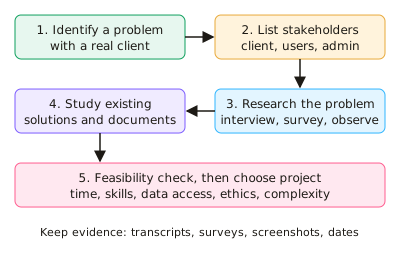
- A good project solves a real problem for a real client and end user. It must be a problem that computational methods can solve, and the student must be able to show the client's input throughout.
- Choose a project with sufficient technical complexity. Examples are a multi-table database with queries, OOP, graphs or trees, or non-trivial algorithms. AQA rewards skills in its Group A, B and C lists. OCR expects complexity that shows a range of techniques.
- Avoid projects that are too simple (a basic calculator or quiz), that rely on drag-and-drop builders, or that need data or equipment you cannot access. Avoid anything that cannot be finished in the available time.
- A stakeholder is anyone with an interest in, or affected by, the system. This includes the client who commissions it, the end users, administrators and the people who maintain it. Different stakeholders may have different or conflicting needs.
- Write open questions for interviews, to get detailed answers and uncover needs you had not predicted. Write closed questions for questionnaires, so answers are easy to count and analyse. Response rate = replies ÷ questionnaires sent × 100.
- Research existing solutions, and screenshot them if possible. Identify the features worth keeping, the limitations, and why they do not fully meet your client's needs. This justifies building something new.
- Keep evidence: dated interview transcripts, blank and completed questionnaires, photographs of documents and screenshots. Then analyse it by stating what each finding means for the system. Examiners reward evidence turned into conclusions, not raw data.
- Carry out a feasibility check on time, your own skills, hardware and software, access to data and the client, and legal and ethical issues. If you collect personal data, follow the Data Protection Act 2018 / UK GDPR: get consent, collect only what is needed and store it securely.
- Finish with a problem statement. It should say what is wrong now, who is affected and why a computer-based solution is suitable. Link this to computational thinking: abstraction, decomposition, automation and processing large amounts of data.
In more detail
- Worked idea: a revision quiz app for a local tutor gives a real client, real users and clear needs.
- Worked stakeholders: the tutor (client), the students (users) and their parents (interested in progress).
- Worked research: interview the client, then study existing apps to see what works and what is missing.
- Worked complexity: plan to include data structures, a non-trivial algorithm (such as spaced-repetition scheduling) and file or database storage.
- Worked suitability: explain how decomposition and abstraction make the problem solvable by computer.
Practice
Choosing a project, identifying stakeholders and researching the problem: 10 questions
Pick an answer to check it, or open the answer for the explanation.
1. Which statement best defines a stakeholder in an NEA project?
- Only the teacher who marks the project
- Only the student who writes the code
- Only the person who pays for the software
- Anyone with an interest in, or affected by, the system
Show answer
D: Anyone with an interest in, or affected by, the system. A stakeholder is any person or group with an interest in, or affected by, the system. This includes the client, end users and administrators, not just the developer or funder.
2. A student needs the views of about 120 pupils within one week. Which research method is most suitable?
- Analysing a competitor's source code
- Observing each pupil for a whole day
- A questionnaire with mostly closed questions
- One-hour individual interviews with each pupil
Show answer
C: A questionnaire with mostly closed questions. Questionnaires reach many people quickly and produce data that is easy to count. Interviews and full-day observation would take far too long for 120 people.
3. Which is a recognised disadvantage of using observation as a research method?
- It can only produce numerical data
- People may behave differently because they know they are watched
- It cannot show how tasks are really carried out
- It must always be followed by a prototype
Show answer
B: People may behave differently because they know they are watched. Observation shows real behaviour, but people being watched may change what they do, which can bias the results. It is not limited to numerical data.
4. What is the main advantage of open questions in a client interview?
- They force the client to choose from a fixed list
- They remove the need to record the interview
- They are quicker to total up statistically
- They allow detailed answers and reveal needs you had not predicted
Show answer
D: They allow detailed answers and reveal needs you had not predicted. Open questions let the client explain in their own words, and often reveal requirements the student had not thought of. Closed questions are easier to count.
5. Which project idea is most suitable for A-level NEA?
- A website made only by re-skinning a template builder
- A program that prints a greeting in colour
- A stock-control system for a named local shop, with a database, searching and reports
- A calculator that adds two numbers
Show answer
C: A stock-control system for a named local shop, with a database, searching and reports. A real client, a multi-table data model and searching or sorting algorithms give enough technical complexity. The other ideas are too simple or lack original programming.
6. Why should a student research existing solutions?
- To copy their code into the project
- To identify useful features and shortcomings, and justify a new system
- To avoid having to talk to the client
- To show the problem has already been solved
Show answer
B: To identify useful features and shortcomings, and justify a new system. Studying existing solutions shows which features to keep and where they fall short of the client's needs, which justifies building a new solution.
7. A student's project needs live access to an airline's private booking database. The airline refuses access. This is mainly a problem of:
- Validation
- Normalisation
- Feasibility
- Portability
Show answer
C: Feasibility. If essential data cannot be obtained, the project is not feasible. Feasibility covers time, skills, equipment, data access and legal or ethical issues.
8. A student's questionnaire will collect pupils' names and health details. What is the most appropriate action under UK data protection law?
- Get consent, collect only what is needed and store it securely
- Publish the results with names so they can be verified
- Keep the answers on a shared USB stick for convenience
- Collect as much data as possible in case it is useful
Show answer
A: Get consent, collect only what is needed and store it securely. The Data Protection Act 2018 / UK GDPR requires lawful, minimal and secure handling of personal data, including consent where needed. Health data is especially sensitive.
9. A questionnaire is sent to 80 users and 56 return it completed. What is the response rate?
- 56%
- 70%
- 30%
- 80%
Show answer
B: 70%. Response rate = 56 ÷ 80 × 100 = 70%. It is calculated from replies received out of questionnaires sent.
10. An interview transcript says: 'Queues form because bookings are on paper.' How should this evidence be used?
- Ignore it, because interviews are not reliable
- Analyse it, cite it and derive a requirement such as online booking
- Copy it into the evaluation as the final result
- Include it only in the appendix with no comment
Show answer
B: Analyse it, cite it and derive a requirement such as online booking. Evidence earns marks when it is analysed and turned into a requirement. Here the paper-based queues point to an online booking feature.
Keep going in Full Marks
Full Marks has 21 questions on Choosing a project, identifying stakeholders and researching the problem (11 more than here), set out in practice levels. You also get notes and 3D models for all 7 subtopics of Programming project (NEA), plus games, timed exams and past papers.
On your exam board
- AQATopic NEA: Non-exam assessment: the computing practical project
- OCRTopic NEA: Programming project (NEA)
Not in the Cambridge specification.