A-level Biology Year 13 · Topic 10
Homeostasis, excretion and hormonal communication
Homeostasis, excretion and hormonal communication is about how the body keeps its internal environment steady.
We will look at negative feedback, temperature control in endotherms and ectotherms, the liver and urea, kidney failure, and how urine is used to test for disease, pregnancy and drugs.
Then we cover how hormones work, how diabetes is treated, and the practical on making a calibration curve to measure glucose concentration.
- 8 subtopics
- 262 questions
- Free: 10.1 notes and 10 questions
In this topic
- 10.1Principles of homeostasis and negative feedbackFree below · 30 questions
- 10.2Thermoregulation in endotherms and ectothermsOpen in Full Marks · 24 questions
- 10.3The liver: structure, deamination, urea and the ornithine cycleOpen in Full Marks · 28 questions
- 10.4Kidney failure: dialysis and transplantationOpen in Full Marks · 30 questions
- 10.5Urine analysis and diagnostic testing (pregnancy and drug tests)Open in Full Marks · 27 questions
- 10.6The endocrine system and mechanisms of hormone actionOpen in Full Marks · 35 questions
- 10.7Treatments for diabetes: insulin, genetically engineered insulin and stem cell researchOpen in Full Marks · 47 questions
- 10.8Practical: dilution series and colorimetric calibration curve for glucose concentrationOpen in Full Marks · 41 questions
10.1 · Free notes
Principles of homeostasis and negative feedback
Key points
- Homeostasis is the maintenance of a relatively stable internal environment (e.g. core temperature, blood glucose concentration, blood pH, water potential, blood pressure) within narrow limits despite external change.
- Control is needed because enzymes and membranes work only in a narrow range of conditions: temperature and pH affect enzyme activity (kinetic energy, denaturation), while glucose and water potential affect respiration and osmosis.
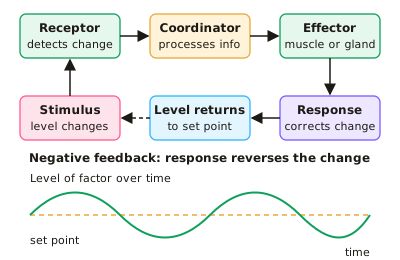
- A control loop has a receptor (detects the stimulus), a coordinator (e.g. hypothalamus, medulla, pancreas; compares the input with the set point) and an effector (muscle or gland) that produces a response.
- Negative feedback: a change away from the set point is detected and the response reverses that change, returning the factor to the set point. Examples are thermoregulation, blood glucose control and osmoregulation.
- Factors fluctuate (oscillate) around the set point because of a time lag between detection and response. Negative feedback keeps variation within narrow limits, which is a dynamic equilibrium, not an exactly constant value.
- Antagonistic effectors (e.g. insulin and glucagon; vasoconstriction and vasodilation) push a factor in opposite directions. This lets a rise or a fall from the set point each be corrected, giving finer control.
- Positive feedback amplifies the original change and moves the factor further from the set point. Examples are oxytocin in labour, platelet plug formation and Na⁺ channels opening during depolarisation. It is not normally homeostatic and ends only when an external event stops it (e.g. birth).
- Nervous coordination is fast, short-lived and localised (electrical impulses). Hormonal coordination is slower, longer-lasting and widespread: hormones travel in the blood and affect only target cells with complementary receptors.
- Many hormones act through second messengers. For example, glucagon or adrenaline binds to its receptor, activating adenylyl cyclase, which converts ATP to cyclic AMP (cAMP); cAMP activates protein kinase A, starting an enzyme cascade that amplifies the signal.
- Calculation tip: percentage deviation = (measured value − set point) ÷ set point × 100. Use the set point as the reference value and give units in the working.
- Exam tip: a full negative feedback answer names the stimulus, receptor, coordinator, effector and response, and states that the factor returns towards the set point. Say the system corrects change in both directions.
In more detail
- Set point: the ideal value a system tries to maintain, e.g. core body temperature about 37 °C and blood glucose about 4–6 mmol dm⁻³.
- Positive feedback examples: oxytocin in childbirth (contractions increase release of more oxytocin), the LH surge before ovulation, and Na⁺ entry during an action potential.
- Worked deviation: body temperature of 38.5 °C compared with a set point of 37.0 °C → (38.5 − 37.0) ÷ 37.0 × 100 = 4.1% above.
- Why separate mechanisms: having separate mechanisms that raise and lower a factor gives faster, finer control than relying on one mechanism switching on or off.
Practice
Principles of homeostasis and negative feedback: 10 questions
Pick an answer to check it, or open the answer for the explanation.
1. Which statement best defines homeostasis?
- Maintaining constant conditions in the blood only
- Keeping the external environment around an organism constant
- Preventing any variation in internal conditions at all times
- Maintaining the internal environment within narrow limits despite external change
Show answer
D: Maintaining the internal environment within narrow limits despite external change. Homeostasis keeps internal conditions (e.g. temperature, glucose, pH) within narrow limits around a set point despite external change. It is dynamic, not absolutely constant.
2. In a negative feedback loop, what is the role of the receptor?
- Releases hormones that reverse the stimulus
- Brings about the corrective response
- Detects a change from the set point and sends information to a coordinator
- Stores the set point and compares it with the stimulus
Show answer
C: Detects a change from the set point and sends information to a coordinator. The receptor detects the stimulus (a change from the set point) and passes information to the coordinator. The coordinator compares it with the set point and the effector produces the response.
3. Which is an example of positive feedback?
- Increased ventilation lowering blood CO₂ concentration
- Insulin lowering blood glucose concentration
- Oxytocin-driven contractions triggering more oxytocin release
- Vasoconstriction of skin arterioles in cold conditions
Show answer
C: Oxytocin-driven contractions triggering more oxytocin release. Oxytocin-stimulated contractions cause more oxytocin release, so the response amplifies the stimulus. The other three reverse the change, which is negative feedback.
4. Why is it advantageous to have two antagonistic effectors controlling one factor, e.g. insulin and glucagon?
- It allows a change in either direction to be corrected
- It raises the set point
- It removes the need for a receptor
- It converts negative feedback into positive feedback
Show answer
A: It allows a change in either direction to be corrected. Antagonistic effectors act in opposite directions, so a rise or a fall from the set point can each be corrected, giving finer control.
5. Why is a persistently high blood glucose concentration harmful to cells?
- It stops glucose entering glycolysis
- It lowers blood water potential, so cells lose water by osmosis
- It raises blood pH and denatures enzymes
- It raises blood water potential, so cells burst
Show answer
B: It lowers blood water potential, so cells lose water by osmosis. High glucose lowers the water potential of blood and tissue fluid, so water leaves cells by osmosis and the cells become dehydrated.
6. The set point for core temperature is 37.0 °C. A patient's reading is 38.2 °C. What is the deviation as a percentage of the set point?
- 32%
- 1.2%
- 3.1%
- 3.2%
Show answer
D: 3.2%. (38.2 − 37.0) ÷ 37.0 × 100 = 3.2%. The deviation is calculated relative to the set point; dividing by the new value would wrongly give 3.1%.
7. Which statement correctly compares hormonal and nervous communication?
- Hormonal responses are faster and more localised
- Hormones affect every cell they reach, whether or not it has receptors
- Nervous responses are usually longer-lasting
- Hormones travel in blood but only affect cells with complementary receptors
Show answer
D: Hormones travel in blood but only affect cells with complementary receptors. Hormones are carried in the blood, but only target cells with complementary receptors respond. Nervous responses are faster, shorter-lived and more localised.
8. A drug blocks chemoreceptors that detect a rise in blood CO₂. What is the most likely effect during exercise?
- Blood CO₂ would fall because feedback becomes positive
- Ventilation rate would rise more quickly
- Heart rate would be the only response, lowering CO₂
- Ventilation would not increase, so blood CO₂ would keep rising
Show answer
D: Ventilation would not increase, so blood CO₂ would keep rising. With no chemoreceptor input, the medulla does not raise ventilation. CO₂ accumulates and blood pH falls, so the negative feedback loop is broken.
9. When glucagon binds to its receptor, cyclic AMP (cAMP) forms. What is the role of cAMP?
- Enters the nucleus and binds to DNA
- Second messenger that activates protein kinase enzymes inside the cell
- Hydrolyses glycogen directly to glucose
- Carries glucagon across the cell membrane
Show answer
B: Second messenger that activates protein kinase enzymes inside the cell. Glucagon binding activates adenylyl cyclase, which makes cAMP. cAMP is a second messenger that activates protein kinase A and starts an amplifying enzyme cascade.
10. Why does a factor controlled by negative feedback fluctuate around the set point rather than stay exactly constant?
- Negative feedback only operates once the set point is exceeded by 10%
- Hormones are destroyed before they reach effectors
- The set point changes every few seconds
- There is a time lag between detecting a change and the response taking effect
Show answer
D: There is a time lag between detecting a change and the response taking effect. Detection, signalling and the effector's action take time, so the factor overshoots slightly before correction, giving fluctuations around the set point.
Keep going in Full Marks
Full Marks has 30 questions on Principles of homeostasis and negative feedback (20 more than here), set out in practice levels. You also get notes and 3D models for all 8 subtopics of Homeostasis, excretion and hormonal communication, plus games, timed exams and past papers.
On your exam board
- AQATopic 6: Organisms respond to changes in their internal and external environments
- OCR ATopic 5.1.1: Communication and homeostasis, Topic 5.1.2: Excretion as an example of homeostatic control, Topic 5.1.4: Hormonal communication
- OCR BTopic 5.3: Control: nervous and hormonal communication, Topic 5.4: Homeostasis
- EdexcelTopic 9: Control systems
- CambridgeTopic 14: Homeostasis, Topic 15: Control and coordination