A-level Biology Year 13 · Topic 7
Genetics, populations, evolution and ecosystems
Genetics, populations, evolution and ecosystems connects what happens to single genes with what happens to whole populations over time.
We will work through inheritance patterns including codominance, sex linkage, autosomal linkage and epistasis, and test our predictions with the chi-squared test.
Then we use the Hardy–Weinberg principle, look at the types of natural selection, genetic drift and speciation, and finish with populations, sampling and succession in ecosystems.
- 8 subtopics
- 277 questions
- Free: 7.1 notes and 10 questions
In this topic
- 7.1InheritanceFree below · 33 questions
- 7.2Populations and Hardy–WeinbergOpen in Full Marks · 35 questions
- 7.3Evolution and speciationOpen in Full Marks · 32 questions
- 7.4Populations in ecosystemsOpen in Full Marks · 70 questions
- 7.5Autosomal linkage and epistasisOpen in Full Marks · 26 questions
- 7.6Chi-squared test for genetic crossesOpen in Full Marks · 22 questions
- 7.7Types of natural selection: stabilising, directional and disruptiveOpen in Full Marks · 31 questions
- 7.8Genetic drift, founder effect and population bottlenecksOpen in Full Marks · 28 questions
7.1 · Free notes
Inheritance
Key points
- Key terms: genotype, phenotype, dominant, recessive, codominant, homozygous, heterozygous and multiple alleles.
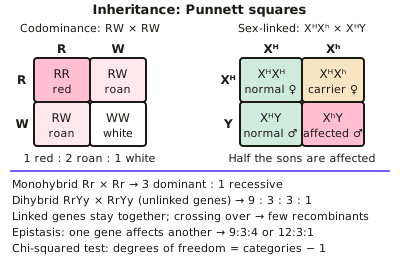
- A monohybrid heterozygous cross gives 3:1; a dihybrid cross of two heterozygotes with unlinked genes gives 9:3:3:1.
- Codominance: both alleles are expressed, for example red × white cattle giving roan offspring.
- Sex linkage: genes on the X chromosome. Males have one X, so a single recessive allele is expressed; examples include haemophilia.
- Autosomal linkage: genes on the same chromosome tend to be inherited together, so fewer recombinant phenotypes appear. Crossing over creates recombinants.
- Epistasis: alleles at one gene locus affect expression of another, giving modified ratios such as 9:3:4 or 12:3:1.
- Chi-squared: χ² = Σ (O − E)² ÷ E. Degrees of freedom = number of categories − 1. If χ² is below the critical value at p = 0.05, the difference is due to chance.
In more detail
- Multiple alleles: a gene with more than two alleles, e.g. ABO blood groups (Iᴬ and Iᴮ codominant, Iᴼ recessive), so a child of AO × BO parents can be any of A, B, AB or O.
- Sex-linked cross: XᴴXʰ (carrier) × XᴴY → daughters all unaffected (half carriers), sons 50% haemophiliac.
- Pedigree clues: a sex-linked recessive trait mainly affects males and is passed from carrier mothers; affected fathers cannot pass it to sons.
- Dihybrid unlinked F2: AaBb × AaBb → 9 A_B_ : 3 A_bb : 3 aaB_ : 1 aabb.
Practice
Inheritance: 10 questions
Pick an answer to check it, or open the answer for the explanation.
1. A carrier mother (XᴴXʰ) and an unaffected father (XᴴY) have sons. What proportion of the sons are expected to have haemophilia?
- 0%
- 25%
- 50%
- 100%
Show answer
C: 50%. Sons get Y from their father and either Xᴴ or Xʰ from their mother, so half are affected.
2. Two roan cattle (codominant red and white alleles) are crossed. What phenotypic ratio is expected?
- 3 red : 1 white
- 1 red : 2 roan : 1 white
- All roan
- 9:3:3:1
Show answer
B: 1 red : 2 roan : 1 white. RW × RW gives RR, RW, RW, WW.
3. A chi-squared test has 4 phenotype categories. How many degrees of freedom are there?
- 2
- 3
- 4
- 5
Show answer
B: 3. Degrees of freedom = categories − 1 = 3.
4. χ² is lower than the critical value at p = 0.05. What do you conclude?
- The difference is significant
- Accept the null hypothesis: the difference is due to chance
- Reject the null hypothesis
- The genes must be linked
Show answer
B: Accept the null hypothesis: the difference is due to chance. There is more than a 5% probability the difference is due to chance.
5. A dihybrid test cross gives mostly parental phenotypes and very few recombinants. What is the best explanation?
- Epistasis
- Autosomal linkage
- Codominance
- Sex linkage
Show answer
B: Autosomal linkage. Linked genes stay together unless crossing over separates them.
6. A cross gives a 9:3:4 ratio. What does this suggest?
- Codominance
- Sex linkage
- Epistasis
- Multiple alleles
Show answer
C: Epistasis. A modified dihybrid ratio shows one gene affecting the expression of another.
7. Parents have blood groups Iᴬiᴼ and Iᴮiᴼ. How many different blood groups could their children have?
- 1
- 2
- 3
- 4
Show answer
D: 4. Offspring can be IᴬIᴮ (AB), Iᴬiᴼ (A), Iᴮiᴼ (B) or iᴼiᴼ (O).
8. Why are X-linked recessive disorders more common in males?
- Males have two X chromosomes
- Males have only one X chromosome, so one recessive allele is expressed
- The Y chromosome carries the allele
- Females cannot inherit them
Show answer
B: Males have only one X chromosome, so one recessive allele is expressed. There is no second X to carry a dominant allele that masks it.
9. What ratio of genotypes (not phenotypes) is expected from crossing two heterozygous individuals for a single gene?
- 1:1
- 1:2:1
- 9:3:3:1
- 3:1
Show answer
B: 1:2:1. BB : Bb : bb occur in a 1:2:1 ratio.
10. Why is a chi-squared test used on genetic cross results?
- To calculate allele frequency
- To test whether observed ratios differ significantly from expected ratios
- To measure mutation rate
- To find the mode of inheritance directly
Show answer
B: To test whether observed ratios differ significantly from expected ratios. It helps decide if any difference from the expected ratio is due to chance.
Keep going in Full Marks
Full Marks has 33 questions on Inheritance (23 more than here), set out in practice levels. You also get notes and 3D models for all 8 subtopics of Genetics, populations, evolution and ecosystems, plus games, timed exams and past papers.
On your exam board
- AQATopic 7: Genetics, populations, evolution and ecosystems
- OCR ATopic 6.1.2: Patterns of inheritance, Topic 6.3.1: Ecosystems
- OCR BTopic 4.2: Populations and ecosystems, Topic 5.1: Genetics and inheritance
- EdexcelTopic 8: Origins of genetic variation, Topic 10: Ecosystems
- CambridgeTopic 16: Inheritance, Topic 17: Selection and evolution, Topic 18: Classification, biodiversity and conservation