A-level Psychology Year 12 · Topic 14
Research methods: further methods, evaluation and practical work
This topic finishes research methods with further techniques and how to judge the quality of research.
We will cover case studies, content and thematic analysis, longitudinal, cross-sectional and cross-cultural designs, pilot studies, types of data and meta-analysis.
Then we look at ethics, reliability and validity, what makes psychology a science, peer review, and how to plan and write up your own study.
- 8 subtopics
- 273 questions
- Free: 14.1 notes and 10 questions
In this topic
- 14.1Case studiesFree below · 24 questions
- 14.2Content analysis and thematic analysisOpen in Full Marks · 33 questions
- 14.3Longitudinal, cross-sectional and cross-cultural research designsOpen in Full Marks · 33 questions
- 14.4Pilot studies, primary and secondary data, and meta-analysisOpen in Full Marks · 68 questions
- 14.5Ethical issues, the BPS Code of Ethics and ethics in animal researchOpen in Full Marks · 32 questions
- 14.6Reliability and validity: assessing and improving themOpen in Full Marks · 27 questions
- 14.7Features of science, peer review and the implications of research for the economyOpen in Full Marks · 28 questions
- 14.8Practical investigation: planning, conducting, analysing and reporting a study (including referencing)Open in Full Marks · 28 questions
14.1 · Free notes
Case studies
Key points
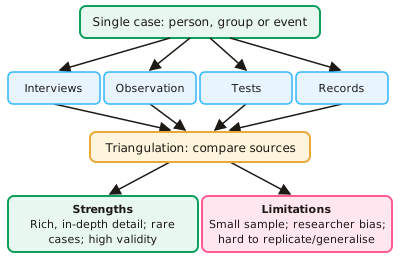
- A case study is an in-depth, detailed investigation of a single individual, small group, institution or event, often studied over a long period (longitudinal). Examples include HM, Genie, Phineas Gage, Little Hans and KF.
- Case studies use multiple sources of data: interviews, observations, psychometric tests, medical or school records and accounts from family and friends. They can produce both qualitative and quantitative data.
- Triangulation means comparing different sources or methods to check that conclusions are consistent. It increases the validity of a case study.
- Strength: rich, detailed data gives a full picture of real-life behaviour, so case studies have high validity and ecological validity. They show how factors interact over time.
- Strength: they allow study of rare or unusual conditions, such as brain damage or extreme deprivation, which could not be created ethically in an experiment.
- Strength: a single case can challenge a theory or generate hypotheses for later testing. For example, KF's impaired STM but intact LTM challenged the multi-store model.
- Weakness: a small, unique sample means findings are hard to generalise to the wider population.
- Weakness: researcher bias and subjective interpretation, especially of qualitative data, reduce objectivity. Researchers often have a close relationship with the case.
- Weakness: retrospective data (for example childhood memories) may be inaccurate or distorted. There is often no baseline (pre-injury or pre-deprivation) measure to compare against.
- Weakness: case studies are hard to replicate, so reliability is low, and they cannot show cause and effect because variables are not controlled.
- Ethical issues: informed consent (the person may lack capacity), confidentiality (unique cases are easily identifiable) and protection from harm. Anonymity, pseudonyms and consent from guardians help.
In more detail
- Classic cases: HM (memory loss after surgery on both medial temporal lobes), Clive Wearing (amnesia after a brain infection), Genie (severe privation) and Little Hans (Freud's phobia case).
- HM's contribution: HM could not form new long-term memories of facts or events, but could learn new motor skills such as mirror drawing, which showed that procedural and declarative memory are separate.
- Worked triangulation: for a child recovering from a brain injury, school reports, parent interviews, IQ tests and brain scans all showing the same pattern make the conclusion more convincing.
- Exam tip: a case study is not a single way of collecting data. It uses other methods, such as interviews, tests and observations, so always say which ones were used.
Practice
Case studies: 10 questions
Pick an answer to check it, or open the answer for the explanation.
1. A psychologist studies one patient, HM, over several decades using interviews, memory tests and brain scans. Which research method is this?
- Cross-sectional study
- Case study
- Natural experiment
- Content analysis
Show answer
B: Case study. A case study is an in-depth investigation of a single individual using several data sources, often over a long period.
2. Why are findings from a case study of one person with brain damage difficult to generalise?
- The sample is a single, unique individual
- The data collected are always quantitative
- Participants are randomly allocated to conditions
- Informed consent can never be obtained
Show answer
A: The sample is a single, unique individual. One unique person may not be representative of the wider population, so conclusions cannot safely be applied to others.
3. A researcher compares a child's interview, school records and parents' reports to check that they agree. What is this process called?
- Standardisation
- Counterbalancing
- Triangulation
- Randomisation
Show answer
C: Triangulation. Triangulation uses multiple sources or methods to cross-check findings, which increases the validity of a case study.
4. Which is a genuine strength of the case study method?
- It is quick and cheap to replicate
- It can investigate rare conditions that cannot ethically be created
- It allows results to be generalised to everyone
- It establishes clear cause and effect
Show answer
B: It can investigate rare conditions that cannot ethically be created. Rare conditions such as brain damage or extreme deprivation cannot ethically be induced, so case studies give unique insight.
5. A researcher uses a patient's recollections of childhood 30 years later to explain her phobia. Which weakness is most relevant?
- Cohort effects between age groups
- Attrition from a longitudinal design
- Retrospective data may be inaccurate or distorted
- Imposed etic from another culture
Show answer
C: Retrospective data may be inaccurate or distorted. Retrospective recall is prone to memory distortion and forgetting, which lowers the validity of the conclusions.
6. Which statement about the data collected in case studies is correct?
- Only quantitative data are collected
- Only qualitative data are collected
- Data come only from laboratory experiments
- Both qualitative and quantitative data may be collected
Show answer
D: Both qualitative and quantitative data may be collected. Case studies combine sources such as interviews (qualitative) and psychometric test scores (quantitative).
7. Researchers have no measure of a patient's personality before an accident. Why does this limit their conclusions about the brain injury?
- Quantitative data cannot be collected
- Without a baseline they cannot be sure what changed
- The sample would be too large to analyse
- The patient could not give consent
Show answer
B: Without a baseline they cannot be sure what changed. A baseline is needed to show what has changed. Without one, the apparent change may be exaggerated or due to other factors.
8. A detailed case study reports a very rare illness and describes the patient's job and town. Which ethical issue is most important?
- Confidentiality, since the person may be identifiable
- Counterbalancing of conditions
- Random allocation to groups
- Deception about the aim
Show answer
A: Confidentiality, since the person may be identifiable. Rare cases are distinctive, so the individual could be recognised. Anonymity and consent must be protected.
9. KF had impaired short-term memory but intact long-term memory, contradicting the multi-store model. What does this show about case studies?
- They are useful because they use large samples
- They always prove a theory correct
- They can challenge theories and generate hypotheses
- They remove all researcher bias
Show answer
C: They can challenge theories and generate hypotheses. A single well-documented case can contradict a theory and lead to new hypotheses being tested.
10. Why is it usually difficult to replicate a case study?
- They are always done in laboratories
- Too many participants are required
- Each case is unique and the circumstances cannot be repeated
- Statistical tests cannot be used
Show answer
C: Each case is unique and the circumstances cannot be repeated. Unique individuals and events cannot be recreated or standardised, so reliability is hard to establish.
Keep going in Full Marks
Full Marks has 24 questions on Case studies (14 more than here), set out in practice levels. You also get notes and 3D models for all 8 subtopics of Research methods: further methods, evaluation and practical work, plus games, timed exams and past papers.