A-level Psychology Year 12 · Topic 2
Psychopathology and approaches
Psychopathology and approaches explores how psychologists define abnormal behaviour, and the different ways they explain behaviour.
We will study definitions of abnormality, and explanations and treatments for phobias, depression and O C D.
Then we compare the main approaches in psychology, and link biopsychology with research methods.
- 12 subtopics
- 347 questions
- Free: 2.1 notes and 6 questions
In this topic
- 2.1PsychopathologyFree below · 12 questions
- 2.2Approaches in psychologyOpen in Full Marks · 24 questions
- 2.3Biopsychology and research methodsOpen in Full Marks · 51 questions
- 2.4Definitions of abnormalityOpen in Full Marks · 19 questions
- 2.5Phobias: characteristics, the behavioural approach and treatmentsOpen in Full Marks · 27 questions
- 2.6Depression: characteristics, the cognitive approach and CBTOpen in Full Marks · 27 questions
- 2.7OCD: characteristics, the biological approach and drug therapyOpen in Full Marks · 22 questions
- 2.8Origins of psychology: Wundt, introspection and psychology as a scienceOpen in Full Marks · 23 questions
- 2.9The cognitive approach: schemas, models and cognitive neuroscienceOpen in Full Marks · 67 questions
- 2.10The psychodynamic approach: FreudOpen in Full Marks · 22 questions
- 2.11Humanistic psychology: Maslow and RogersOpen in Full Marks · 30 questions
- 2.12Comparison of approachesOpen in Full Marks · 23 questions
2.1 · Free notes
Psychopathology
Key points
- Definitions of abnormality: statistical infrequency, deviation from social norms, failure to function adequately and deviation from ideal mental health.
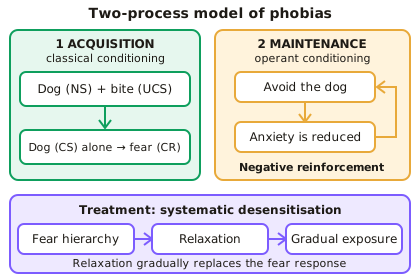
- Phobias: behavioural (avoidance, panic), emotional (fear) and cognitive (irrational beliefs) characteristics; explained by the two-process model (classical conditioning to acquire, operant conditioning to maintain) and treated with systematic desensitisation and flooding.
- Depression: characteristics include low mood, reduced activity and negative thinking; explained by Beck's negative triad and Ellis's ABC model, treated with CBT.
- OCD: obsessions (cognitive) and compulsions (behavioural); biological explanations include genetic vulnerability (candidate genes) and neural factors (low serotonin, abnormal frontal lobe function), treated with SSRIs.
- Each definition and explanation has limitations, such as cultural relativism in social norms.
In more detail
- Jahoda's ideal mental health (1958): positive self-attitude, self-actualisation, autonomy, resistance to stress, accurate perception of reality and mastery of the environment.
- Statistical infrequency: an IQ below 70 affects only about 2% of people, so it is statistically unusual.
- Ellis's ABC model: an Activating event, irrational Beliefs (such as "I must be perfect"), and emotional Consequences.
- OCD genes: the SLC6A4 and COMT genes have been linked to OCD.
- SSRIs for OCD: reviews show SSRIs work better than a placebo, especially combined with CBT.
Practice
Psychopathology: 6 questions
Pick an answer to check it, or open the answer for the explanation.
1. What is the two-process model used to explain?
- Depression
- Phobias: acquired by classical conditioning and maintained by operant conditioning
- OCD only
- Schizophrenia
Show answer
B: Phobias: acquired by classical conditioning and maintained by operant conditioning. Avoidance is negatively reinforced by reduced anxiety.
2. What is Beck's negative triad?
- Three therapies for depression
- Negative views of the self, the world and the future
- Three symptoms of OCD
- A drug treatment
Show answer
B: Negative views of the self, the world and the future. These cognitive biases maintain depression.
3. What treatment is most associated with phobias?
- SSRIs
- Systematic desensitisation
- ECT
- Psychosurgery
Show answer
B: Systematic desensitisation. It gradually pairs the feared stimulus with relaxation.
4. Which biological treatment is used for OCD?
- Systematic desensitisation
- SSRIs
- Flooding
- REBT
Show answer
B: SSRIs. SSRIs increase serotonin availability in the synapse.
5. What is a limitation of 'deviation from social norms' as a definition of abnormality?
- It is objective
- Norms vary between cultures and over time, so it can be relative and open to abuse
- It requires statistics
- It ignores behaviour
Show answer
B: Norms vary between cultures and over time, so it can be relative and open to abuse. What is abnormal in one culture may be normal in another.
6. What is a common behavioural characteristic of a phobia?
- Increased social contact with the feared stimulus
- Avoidance of the feared object or situation
- Improved concentration
- Increased appetite
Show answer
B: Avoidance of the feared object or situation. Avoidance reduces anxiety in the short term, maintaining the phobia.
Keep going in Full Marks
Full Marks has 12 questions on Psychopathology (6 more than here), set out in practice levels. You also get notes and 3D models for all 12 subtopics of Psychopathology and approaches, plus games, timed exams and past papers.