A-level Maths Year 12 · Topic 2
Trigonometry, exponentials and logarithms in depth
Trigonometry, exponentials and logarithms in depth develops tools for triangles, waves and growth.
We will use the sine and cosine rules, trigonometric graphs and identities, and solve trigonometric equations in a given range.
Then we use radians for arcs and sectors, and study exponentials, logarithms, and how to model growth and decay with straight-line graphs.
- 7 subtopics
- 361 questions
- Free: 2.1 notes and 10 questions
In this topic
- 2.1Sine rule, cosine rule and area of a triangleFree below · 63 questions
- 2.2Trigonometric graphs, exact values and the identities tan x = sin x / cos x and sin²x + cos²x = 1Open in Full Marks · 49 questions
- 2.3Solving trigonometric equations in a given intervalOpen in Full Marks · 46 questions
- 2.4Radian measure, arc length and sector areaOpen in Full Marks · 61 questions
- 2.5Exponential functions y = a^x and e^x; gradient of e^kxOpen in Full Marks · 45 questions
- 2.6Logarithms: laws of logarithms, ln x and solving a^x = bOpen in Full Marks · 43 questions
- 2.7Using logarithms to reduce y = ax^n and y = kb^x to linear form and modelling exponential growth and decayOpen in Full Marks · 54 questions
2.1 · Free notes
Sine rule, cosine rule and area of a triangle
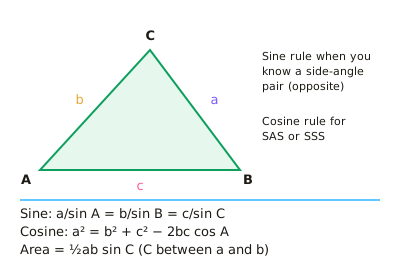
Key points
- Label a triangle so that side a is opposite angle A, side b is opposite angle B and side c is opposite angle C. Always sketch and label it first.
- Sine rule: a/sin A = b/sin B = c/sin C. Use it when you know a side and its opposite angle (a matching pair), e.g. AAS, ASA or SSA.
- Cosine rule: a² = b² + c² − 2bc cos A. Use it for SAS (two sides and the included angle) to find the third side.
- Rearranged cosine rule: cos A = (b² + c² − a²)/(2bc). Use it for SSS to find an angle; it handles obtuse angles correctly because cos is negative for them.
- Area of a triangle = ½ab sin C, where C is the included angle between sides a and b. Area is in square units (cm², m²).
- Ambiguous case (SSA): sin B = k gives B and 180° − B. Accept the second angle only if the angle sum stays below 180°. A triangle with two possible answers is typical when the given angle is acute and a < b.
- The angles sum to 180° and the largest angle is opposite the longest side. Use this to check that answers are sensible.
- The sine rule cannot tell an acute angle from an obtuse one. If an angle might be obtuse, use the cosine rule to find it.
- Keep full calculator values until the end and check the calculator is in degrees mode. Give lengths to 3 s.f. and angles to 1 d.p. unless told otherwise.
- Bearings are measured clockwise from north using three figures (e.g. 040°). Draw a north line at each point and use parallel-line angles to find the angle inside the triangle.
- If C = 90° then cos C = 0, so the cosine rule reduces to Pythagoras' theorem. A good check on a formula.
In more detail
- Worked sine rule: a = 9, A = 50°, B = 70° → C = 60°; b = 9 sin 70° ÷ sin 50° = 11.0 and c = 9 sin 60° ÷ sin 50° = 10.2.
- Worked cosine rule for an angle: sides 5, 6 and 8 → cos C = (25 + 36 − 64) ÷ (2 × 5 × 6) = −0.05 → C = 92.9°.
- Worked ambiguous case: a = 7, b = 9, A = 40° → sin B = 9 sin 40° ÷ 7 = 0.826 → B = 55.7° or 124.3° (both fit, since 40° + 124.3° < 180°).
- Worked area: sides 8 and 11 with 35° between them → ½ × 8 × 11 × sin 35° = 25.2.
- Worked bearings: 12 km on 040° then 8 km on 130° → the paths meet at 90°, so the distance from the start is √(144 + 64) = 14.4 km.
Practice
Sine rule, cosine rule and area of a triangle: 10 questions
Pick an answer to check it, or open the answer for the explanation.
1. A triangle has sides a = 8 cm and b = 11 cm with included angle C = 40°. What is its area?
- 28.3 cm²
- 14.1 cm²
- 33.7 cm²
- 56.6 cm²
Show answer
A: 28.3 cm². Area = ½ab sin C = ½ × 8 × 11 × sin 40° = 44 × 0.6428 = 28.3 cm². Using cos gives 33.7, and omitting the ½ gives 56.6.
2. You know two sides of a triangle and the angle between them. Which rule should you use first to find the third side?
- Pythagoras' theorem
- Cosine rule
- Sine rule
- Area formula ½ab sin C
Show answer
B: Cosine rule. Two sides and the included angle (SAS) gives no matching side-angle pair, so the sine rule cannot start. The cosine rule finds the third side.
3. In triangle ABC, a = 7 cm, b = 9 cm and C = 60°. Find c to 3 s.f.
- 8.19 cm
- 13.9 cm
- 11.4 cm
- 33.5 cm
Show answer
A: 8.19 cm. c² = 7² + 9² − 2(7)(9)cos 60° = 130 − 63 = 67, so c = 8.19 cm. 11.4 ignores the cosine term and 13.9 adds it.
4. In triangle ABC, A = 35°, B = 80° and a = 6 cm. Find side b to 3 s.f.
- 10.3 cm
- 8.43 cm
- 3.49 cm
- 1.27 cm
Show answer
A: 10.3 cm. b/sin 80° = 6/sin 35°, so b = 6 sin 80°/sin 35° = 10.3 cm. 3.49 comes from inverting the ratio.
5. A triangle has sides 5 cm, 6 cm and 7 cm. What is its largest angle to 1 d.p.?
- 78.5°
- 44.4°
- 101.5°
- 57.1°
Show answer
A: 78.5°. The largest angle is opposite 7 cm: cos C = (25 + 36 − 49)/(2 × 5 × 6) = 0.2, so C = 78.5°. 44.4° and 57.1° are the other two angles.
6. In triangle ABC, A = 30°, a = 5 cm and b = 8 cm. How many different triangles can be drawn?
- 3
- 0
- 1
- 2
Show answer
D: 2. sin B = 8 sin 30°/5 = 0.8, so B = 53.1° or 126.9°. Both leave an angle sum below 180° with A = 30°, so two triangles exist.
7. In the area formula Area = ½ab sin C, which statement is correct?
- C must be a right angle
- C is the angle between sides a and b
- C is the angle opposite side a
- C can be any angle of the triangle
Show answer
B: C is the angle between sides a and b. The formula needs the included angle, the one between the two sides used. Using any other angle gives a wrong area.
8. A ship sails 12 km on a bearing of 040°, then 9 km on a bearing of 130°. How far is it from its start?
- 21 km
- 19.8 km
- 9.3 km
- 15 km
Show answer
D: 15 km. The bearings differ by 90°, so the two legs meet at a right angle: distance = √(12² + 9²) = 15 km. The cosine rule with 90° agrees.
9. A triangle has sides 10 cm, 10 cm and 12 cm. What is its area?
- 96 cm²
- 50 cm²
- 60 cm²
- 48 cm²
Show answer
D: 48 cm². cos C = (100 + 100 − 144)/200 = 0.28, so sin C = 0.96. Area = ½ × 10 × 10 × 0.96 = 48 cm². Check: base 12, height 8 gives ½ × 12 × 8 = 48.
10. A triangle has area 20 cm². Two sides are 8 cm and 10 cm, enclosing an acute angle θ. Find θ.
- 60°
- 150°
- 14.5°
- 30°
Show answer
D: 30°. 20 = ½ × 8 × 10 × sin θ, so sin θ = 0.5 and θ = 30°. 150° is obtuse; 14.5° comes from forgetting the ½.
Keep going in Full Marks
Full Marks has 63 questions on Sine rule, cosine rule and area of a triangle (53 more than here), set out in practice levels. You also get notes and 3D models for all 7 subtopics of Trigonometry, exponentials and logarithms in depth, plus games, timed exams and past papers.
On your exam board
- AQATopic 5: Trigonometry, Topic 6: Exponentials and logarithms
- OCR ATopic 5: Trigonometry, Topic 6: Exponentials and logarithms
- OCR BTopic 5: Trigonometry, Topic 6: Exponentials and logarithms
- EdexcelTopic 5: Trigonometry, Topic 6: Exponentials and logarithms
- CambridgeTopic 1.4: Circular measure, Topic 1.5: Trigonometry