A-level Economics Year 12 · Topic 1
Microeconomics
This topic sets out the core ideas of microeconomics: scarcity, choice and how markets allocate resources.
We will cover economics as a social science, opportunity cost and production possibility frontiers, factors of production, specialisation and money.
Then we compare economic systems, and see how behavioural economics challenges the idea that people always act rationally.
- 7 subtopics
- 202 questions
- Free: 1.1 notes and 7 questions
In this topic
- 1.1The economic problem and price determinationFree below · 13 questions
- 1.2Production, costs and market failureOpen in Full Marks · 37 questions
- 1.3Economics as a social science: positive and normative statements, ceteris paribus and the scientific methodOpen in Full Marks · 21 questions
- 1.4Scarcity, choice, opportunity cost and production possibility frontiersOpen in Full Marks · 43 questions
- 1.5Factors of production, specialisation, division of labour, trade and moneyOpen in Full Marks · 27 questions
- 1.6Economic systems: free market, mixed and command economies and the allocation of resourcesOpen in Full Marks · 24 questions
- 1.7Rational decision making and behavioural economics (bounded rationality, nudge, heuristics)Open in Full Marks · 37 questions
1.1 · Free notes
The economic problem and price determination
Key points
- Economics distinguishes positive statements (testable facts) from normative statements (value judgements).
- The PPF illustrates scarcity, choice and opportunity cost; economic growth shifts it outwards.
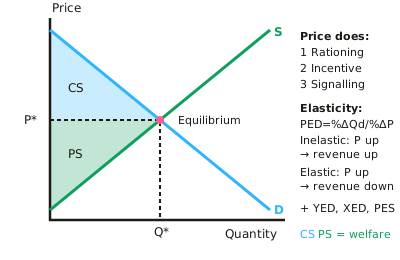
- Demand and supply interact to set equilibrium price; the price mechanism performs rationing, incentive and signalling functions.
- Elasticities: PED (responsiveness of demand to price), YED (to income), XED (to the price of another good) and PES (supply to price).
- PED affects total revenue: raising price increases revenue when demand is inelastic and reduces it when demand is elastic.
- Consumer and producer surplus measure welfare gains from market exchange.
In more detail
- Worked PED and revenue: a cinema raises tickets from £10 to £12 (+20%) and sales fall from 500 to 450 (−10%) → PED = −0.5, and revenue rises from £5,000 to £5,400.
- Worked consumer surplus: if you would pay up to £30 for a concert ticket and it costs £20, your consumer surplus is £10.
- XED example: a sharp rise in the price of petrol raises demand for electric cars, a positive XED, so they act as substitutes.
- Exam tip: for every market question, draw the diagram, identify the shift and its cause, then use elasticity to judge the size of the effect.
Practice
The economic problem and price determination: 7 questions
Pick an answer to check it, or open the answer for the explanation.
1. PED is −2. Demand is:
- Inelastic
- Unit elastic
- Price elastic
- Perfectly inelastic
Show answer
C: Price elastic. The absolute value is greater than 1.
2. If demand is price inelastic, raising price will:
- Reduce total revenue
- Increase total revenue
- Leave revenue unchanged
- Eliminate demand
Show answer
B: Increase total revenue. Quantity falls proportionally less than price rises.
3. A good with negative income elasticity of demand is:
- A normal good
- A luxury
- An inferior good
- A complement
Show answer
C: An inferior good. Demand falls as income rises.
4. Which is a normative statement?
- Inflation was 3% last year
- The government should reduce inequality
- Unemployment rose in June
- GDP grew by 1%
Show answer
B: The government should reduce inequality. Normative statements involve value judgements.
5. What is consumer surplus?
- The amount firms earn above costs
- The difference between what consumers are willing to pay and what they actually pay
- Total spending
- Excess supply
Show answer
B: The difference between what consumers are willing to pay and what they actually pay. It measures consumer welfare from a transaction.
6. If income elasticity of demand is positive, the good is:
- An inferior good
- A normal good
- A public good
- A merit good
Show answer
B: A normal good. Demand rises as income rises for a normal good.
7. What does producer surplus measure?
- The amount consumers overpay
- The difference between the price producers receive and the minimum they would accept
- Total revenue
- Total cost of production
Show answer
B: The difference between the price producers receive and the minimum they would accept. It represents a welfare gain to producers from market exchange.
Keep going in Full Marks
Full Marks has 13 questions on The economic problem and price determination (6 more than here), set out in practice levels. You also get notes and 3D models for all 7 subtopics of Microeconomics, plus games, timed exams and past papers.
On your exam board
- AQATopic 1: Economic methodology and the economic problem, Topic 3: Production, costs and revenue
- OCRTopic 1.1: The economic problem, Topic 1.2: Resource allocation, Topic 1.4: Market failure
- EdexcelTopic 1.1: Nature of economics, Topic 1.2: How markets work, Topic 1.3: Market failure
- CambridgeTopic 1: Basic economic ideas and resource allocation, Topic 2: The price system and the microeconomy