A-level Computer Science Year 12 · Topic 4
Networking and consequences of computing
Networking and the consequences of computing covers how networks communicate, and the wider effects of technology on society.
We will look at network models, topologies and transmission media, and how data is transmitted.
Then we study Wi-Fi and its security, and the ethical, legal and cultural consequences of computing.
- 5 subtopics
- 251 questions
- Free: 4.1 notes and 10 questions
In this topic
- 4.1Communication and networkingFree below · 65 questions
- 4.2Consequences of computingOpen in Full Marks · 25 questions
- 4.3Network topologies, transmission media and wired vs wireless networksOpen in Full Marks · 68 questions
- 4.4Data transmission: serial and parallel, synchronous and asynchronous, bit rate, baud rate, bandwidth and latencyOpen in Full Marks · 64 questions
- 4.5Wi-Fi: CSMA/CA, SSID, wireless access points and wireless securityOpen in Full Marks · 29 questions
4.1 · Free notes
Communication and networking
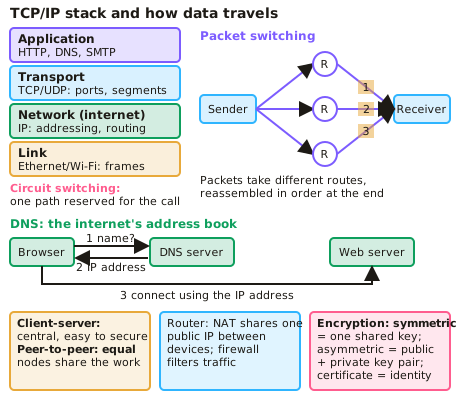
Key points
- The TCP/IP stack has four layers: application, transport, network (internet) and link.
- Packet switching splits data into packets routed independently and reassembled at the destination; circuit switching reserves a path for the whole transmission.
- Client-server models centralise resources and security; peer-to-peer distributes them between equal nodes.
- IP addressing identifies devices; DNS converts domain names into IP addresses. NAT and firewalls help manage and protect traffic.
- Encryption (symmetric and asymmetric/public key) protects data in transit; digital certificates support authentication.
In more detail
- Worked transfer time: 500 MB over a 100 Mbit/s link → 4000 Mbit ÷ 100 = 40 s, plus any latency.
- Worked client–server: a browser sends an HTTP GET request; the web server replies with the HTML, CSS and JavaScript files.
- Worked peer-to-peer: BitTorrent downloads different pieces of a file from many peers at once.
- Thin vs thick client: a thin client relies on the server for processing, like a cloud desktop; a thick client processes locally, like a gaming PC.
- Why standards matter: devices from different manufacturers can communicate because they follow the same protocols.
Practice
Communication and networking: 10 questions
Pick an answer to check it, or open the answer for the explanation.
1. How many layers does the TCP/IP stack have?
- Two
- Four
- Five
- Seven
Show answer
B: Four. Application, transport, network and link.
2. What does DNS do?
- Encrypts data
- Converts domain names into IP addresses
- Stores web pages
- Routes packets physically
Show answer
B: Converts domain names into IP addresses. It acts like the internet's address book.
3. What is packet switching?
- Reserving one path for a whole transmission
- Splitting data into packets routed independently and reassembled at the destination
- Encrypting every packet
- Sending data as a single block
Show answer
B: Splitting data into packets routed independently and reassembled at the destination. This uses network capacity efficiently and is resilient.
4. What is asymmetric encryption?
- The same key encrypts and decrypts
- A public key encrypts and a matching private key decrypts
- No key is needed
- Only used offline
Show answer
B: A public key encrypts and a matching private key decrypts. This solves the problem of securely sharing keys.
5. What is an advantage of a client-server network?
- No server is needed
- Centralised security, backups and resource management
- Every device stores everything
- It works without any software
Show answer
B: Centralised security, backups and resource management. Management and updates are easier to control centrally.
6. Which layer of the TCP/IP stack handles end-to-end delivery and packet ordering?
- Application
- Transport
- Network
- Link
Show answer
B: Transport. TCP operates at the transport layer.
7. What is symmetric encryption?
- Different keys for encrypting and decrypting
- The same key used to encrypt and decrypt
- No key at all
- Public key only
Show answer
B: The same key used to encrypt and decrypt. Key distribution is its main weakness.
8. What is the purpose of a digital certificate?
- To compress data
- To verify the identity of a server or sender
- To route packets
- To store passwords
Show answer
B: To verify the identity of a server or sender. Certificates are issued by trusted authorities.
9. Ignoring overheads, how long does a 6 MB file take to send over a 48 Mbit/s link?
- 0.125 s
- 1 s
- 6 s
- 8 s
Show answer
B: 1 s. 6 MB × 8 = 48 Mbit, and 48 Mbit ÷ 48 Mbit/s = 1 s. Forgetting to convert bytes to bits gives the tempting 0.125 s.
10. Which is a disadvantage of circuit switching compared with packet switching?
- Packets arrive out of order
- Reserved capacity is wasted when no data is sent
- Every packet needs its own address
- Data cannot be sent in real time
Show answer
B: Reserved capacity is wasted when no data is sent. The dedicated path stays reserved even during silences, so bandwidth is wasted. Out-of-order packets are a packet-switching issue, not a circuit-switching one.
Keep going in Full Marks
Full Marks has 65 questions on Communication and networking (55 more than here), set out in practice levels. You also get notes and 3D models for all 5 subtopics of Networking and consequences of computing, plus games, timed exams and past papers.