A-level Chemistry Year 12 · Topic 5
Organic basics: alkanes and halogenoalkanes
Organic basics introduces the language of organic chemistry and the first two families of compounds: alkanes and halogenoalkanes.
We will learn how to name compounds, draw different types of formula, recognise isomers and use curly arrows to show mechanisms.
Then we study the combustion and free-radical reactions of alkanes, nucleophilic substitution and elimination in halogenoalkanes, and how CFCs damage the ozone layer.
- 5 subtopics
- 138 questions
- Free: 5.1 notes and 10 questions
In this topic
- 5.1Introduction to organic chemistryFree below · 26 questions
- 5.2AlkanesOpen in Full Marks · 30 questions
- 5.3HalogenoalkanesOpen in Full Marks · 32 questions
- 5.4Ozone depletion by CFCs and radical chain reactions in the atmosphereOpen in Full Marks · 30 questions
- 5.5Crude oil, fractional distillation, fuels and pollution from combustionOpen in Full Marks · 20 questions
5.1 · Free notes
Introduction to organic chemistry
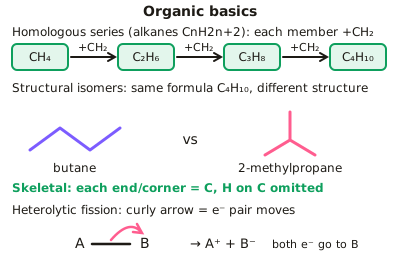
Key points
- Organic compounds are named systematically using IUPAC rules based on the longest carbon chain and functional groups present.
- A homologous series is a family of compounds with the same general formula and similar chemical properties, differing by a CH₂ unit between members.
- Structural isomers have the same molecular formula but different structural arrangements of atoms.
- Skeletal formula shows only the carbon skeleton and functional groups, with hydrogens on carbon usually omitted.
- Curly arrows show the movement of an electron pair in a reaction mechanism; heterolytic fission is when a bond breaks and both electrons go to one atom, forming ions.
In more detail
- Formula types: molecular (C₄H₁₀), structural (CH₃CH₂CH₂CH₃), displayed (all bonds shown), skeletal (zigzag lines, with C and H on carbon not shown), general (CₙH₂ₙ₊₂).
- Types of structural isomerism: chain (different carbon skeleton, e.g. butane and methylpropane), position (functional group in a different place, e.g. propan-1-ol and propan-2-ol), functional group (e.g. an aldehyde and a ketone).
- Naming steps: find the longest chain (stem), number from the end nearest the functional group, name and number substituents in alphabetical order, e.g. 2-methylbutane.
- Homolytic vs heterolytic fission: homolytic gives two radicals (one electron each); heterolytic gives a cation and an anion (both electrons go to one atom).
Practice
Introduction to organic chemistry: 10 questions
Pick an answer to check it, or open the answer for the explanation.
1. What is a homologous series?
- A group of unrelated compounds
- A family of compounds with the same general formula and similar properties, differing by CH₂
- A single compound
- A type of catalyst
Show answer
B: A family of compounds with the same general formula and similar properties, differing by CH₂. Each member differs from the next by one CH₂ unit.
2. What are structural isomers?
- Compounds with different molecular formulae
- Compounds with the same molecular formula but a different structural arrangement
- Identical compounds
- Isotopes of carbon
Show answer
B: Compounds with the same molecular formula but a different structural arrangement. The atoms are connected differently despite the same formula.
3. What does a skeletal formula show?
- Every atom and bond
- Only the carbon skeleton and functional groups, with most hydrogens omitted
- Only hydrogen atoms
- The 3D shape only
Show answer
B: Only the carbon skeleton and functional groups, with most hydrogens omitted. This makes larger molecules quicker to draw.
4. What does a curly arrow represent in a mechanism?
- The movement of a whole atom
- The movement of a pair of electrons
- A change in temperature
- The direction of a reaction only
Show answer
B: The movement of a pair of electrons. The arrow starts at the electron source and points to where they end up.
5. What is heterolytic fission?
- A bond breaks and each atom gets one electron
- A bond breaks and both electrons go to one atom
- No bond breaks
- Two bonds form simultaneously
Show answer
B: A bond breaks and both electrons go to one atom. This forms two oppositely charged ions.
6. What is the empirical formula shown by a skeletal formula's line ends?
- Oxygen atoms
- Carbon atoms with implied hydrogens
- Nitrogen atoms
- Nothing
Show answer
B: Carbon atoms with implied hydrogens. Each line end or junction represents a carbon atom.
7. What is the systematic name of CH₃CH(CH₃)CH₂CH₃?
- 2-methylbutane
- 3-methylbutane
- 2-ethylpropane
- Pentane
Show answer
A: 2-methylbutane. The longest chain has four carbons (butane) with a methyl branch. Numbering from the end that gives the lowest locant makes it 2-methylbutane, not 3-methylbutane.
8. How many structural isomers have the molecular formula C₄H₁₀?
- 1
- 2
- 3
- 4
Show answer
B: 2. Only two exist: butane (straight chain) and methylpropane (branched). Rotating a chain does not give a new isomer.
9. Butan-1-ol and butan-2-ol are structural isomers. What type of isomerism is this?
- Position
- Functional group
- Geometric
- Chain
Show answer
A: Position. Both have a four-carbon chain and an –OH group. The –OH is on a different carbon, so they are position isomers.
10. Ethanol (CH₃CH₂OH) and methoxymethane (CH₃OCH₃) are isomers. What type of isomerism is this?
- Chain isomerism
- E/Z isomerism
- Positional isomerism
- Functional group isomerism
Show answer
D: Functional group isomerism. Both are C₂H₆O but one is an alcohol (–OH) and the other an ether (C–O–C). Different functional groups means functional group isomerism.
Keep going in Full Marks
Full Marks has 26 questions on Introduction to organic chemistry (16 more than here), set out in practice levels. You also get notes and 3D models for all 5 subtopics of Organic basics: alkanes and halogenoalkanes, plus games, timed exams and past papers.
On your exam board
- AQATopic 3.3.1: Introduction to organic chemistry, Topic 3.3.2: Alkanes, Topic 3.3.3: Halogenoalkanes
- OCR ATopic 4.1.1: Basic concepts of organic chemistry, Topic 4.1.2: Alkanes, Topic 4.2.2: Haloalkanes
- OCR BTopic DF: Developing fuels, Topic OZ: The ozone story
- EdexcelTopic 6: Organic chemistry I
- CambridgeTopic 13: An introduction to AS Level organic chemistry, Topic 14: Hydrocarbons, Topic 15: Halogen compounds