A-level Business Year 12 · Topic 10
Quantitative skills and exam technique
This topic pulls together the number skills and exam technique you need across the whole course.
We practise percentages, index numbers and data interpretation, then show how to build analysis and evaluation into strong answers.
- 4 subtopics
- 221 questions
- Free: 10.1 notes and 10 questions
In this topic
- 10.1Quantitative skills: percentages, percentage change, ratios, averages, index numbers and roundingFree below · 41 questions
- 10.2Presenting and interpreting data: tables, graphs, charts, trends and time seriesOpen in Full Marks · 59 questions
- 10.3Using quantitative and qualitative data to support business decisionsOpen in Full Marks · 71 questions
- 10.4Exam technique: command words, case study use, analysis, evaluation and judgementOpen in Full Marks · 50 questions
10.1 · Free notes
Quantitative skills: percentages, percentage change, ratios, averages, index numbers and rounding
Key points
- Percentage = (part ÷ whole) × 100. For example, market share = (firm's sales ÷ total market sales) × 100.
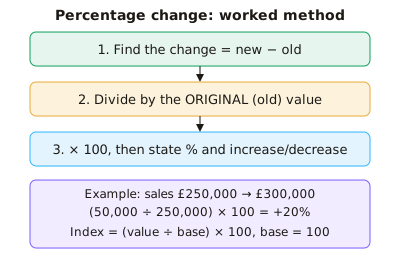
- Percentage change = (new − old) ÷ old × 100. Always divide by the original value and say whether it is an increase or a decrease.
- A change in a percentage (profit margin 8% to 10%) is a percentage point change of 2. The relative change is 2 ÷ 8 × 100 = 25%. Examiners penalise mixing these up.
- Ratios are simplified by dividing by the highest common factor. To share an amount in the ratio a:b, divide by (a + b), then multiply by each part.
- Mean = total ÷ number of values. Median = middle value of ordered data. Mode = most frequent value. An outlier distorts the mean, so the median is often the better 'typical' value.
- Index number = (value ÷ base-year value) × 100. The base year = 100, so an index of 125 means 25% above the base. Indices let you compare series with different units.
- The percentage change between two index values uses the same formula: (new index − old index) ÷ old index × 100. It is not simply the difference in index points unless the old index is 100.
- Reverse percentage: original = new ÷ (1 + change as a decimal). For example, £60 after a 20% rise gives £60 ÷ 1.2 = £50.
- Rounding: use the decimal places or significant figures asked for. Keep full calculator values during working and round only the final answer.
- Common formulae: profit margin = profit ÷ revenue × 100; labour productivity = output ÷ number of workers; labour turnover = leavers ÷ average workforce × 100.
- Always show formula, substitution, answer and units (£, %, units, years). Method marks are awarded even if the final answer is wrong.
- Check plausibility. A negative result means a decrease, and a percentage fall cannot exceed 100%.
In more detail
- Worked reverse percentage: sales after a 25% rise are £150,000 → original = 150,000 ÷ 1.25 = £120,000.
- Worked index: sales of £2.4m in the base year (index 100) and £2.76m two years later → index = 2.76 ÷ 2.4 × 100 = 115.
- Index change trap: an index rising from 115 to 126.5 is a rise of 10%, not 11.5%.
- Worked ratio share: £90,000 of profit shared 2:3:4 between three partners gives £20,000, £30,000 and £40,000.
Practice
Quantitative skills: percentages, percentage change, ratios, averages, index numbers and rounding: 10 questions
Pick an answer to check it, or open the answer for the explanation.
1. Sales rose from £250,000 to £300,000. What is the percentage increase?
- 25%
- 16.7%
- 50%
- 20%
Show answer
D: 20%. (300,000 − 250,000) ÷ 250,000 × 100 = 20%. Divide by the original value; dividing by the new value gives the incorrect 16.7%.
2. A firm has sales of £4.5m in a market worth £30m. What is its market share?
- 13.5%
- 6.7%
- 15%
- 85%
Show answer
C: 15%. Market share = firm sales ÷ total market sales × 100 = 4.5 ÷ 30 × 100 = 15%.
3. A firm's profit margin rises from 8% to 10%. Which statement is correct?
- It rose by 2%
- It rose by 20 percentage points
- It rose by 2 percentage points, a 20% relative rise
- It rose by 2 percentage points, a 25% relative rise
Show answer
D: It rose by 2 percentage points, a 25% relative rise. The absolute change is 2 percentage points. Relative change = 2 ÷ 8 × 100 = 25%, because you divide by the original margin.
4. Profit of £48,000 is shared between two partners in the ratio 5:3. How much does the larger share receive?
- £30,000
- £28,800
- £32,000
- £18,000
Show answer
A: £30,000. 5 + 3 = 8 parts. £48,000 ÷ 8 = £6,000 per part. 5 × £6,000 = £30,000.
5. Weekly output of five workers is 12, 15, 15, 18 and 40 units. What is the median?
- 20
- 18
- 15
- 40
Show answer
C: 15. Ordered data: 12, 15, 15, 18, 40. The middle value is 15. The mean is 20 because the outlier of 40 pulls it upwards.
6. A price index (2020 = 100) stands at 126 in 2024. The 2020 price was £50. What was the 2024 price?
- £126
- £63
- £76
- £52.60
Show answer
B: £63. The index shows a 26% rise. £50 × 126 ÷ 100 = £63.
7. A cost index rises from 120 to 150. What is the percentage increase in costs?
- 25%
- 30%
- 20%
- 1.25%
Show answer
A: 25%. (150 − 120) ÷ 120 × 100 = 25%. The 30 index points are not a 30% rise, because the old index is not 100.
8. 0.004567 rounded to 3 significant figures is:
- 0.0046
- 0.00457
- 0.005
- 0.00456
Show answer
B: 0.00457. The first significant figure is the 4. The three significant figures are 4, 5, 6, and the next digit 7 rounds the 6 up to 0.00457.
9. After a 20% price rise, a product costs £60. What was the original price?
- £72
- £48
- £52
- £50
Show answer
D: £50. Original = £60 ÷ 1.2 = £50. Taking 20% off £60 (giving £48) is the common error, because the 20% was based on the original price.
10. A price is raised by 10% and then cut by 10%. Compared with the original price, the final price is:
- The same
- 10% lower
- 1% lower
- 1% higher
Show answer
C: 1% lower. 1.10 × 0.90 = 0.99, so the final price is 99% of the original, which is 1% lower. The second change applies to a larger base.
Keep going in Full Marks
Full Marks has 41 questions on Quantitative skills: percentages, percentage change, ratios, averages, index numbers and rounding (31 more than here), set out in practice levels. You also get notes and 3D models for all 4 subtopics of Quantitative skills and exam technique, plus games, timed exams and past papers.
On your exam board
- AQATopic Q: Quantitative skills and exam technique
- OCRTopic Q: Quantitative skills and exam technique
- EdexcelTopic Q: Quantitative skills and exam technique
Not in the Cambridge specification.