A-level Business Year 12 · Topic 1
Business objectives, marketing and operations
This topic sets out what a business is, what it is trying to achieve and who owns it.
We look at mission, aims and objectives, opportunity cost and added value, and the different legal forms a business can take.
We finish with franchises, social enterprises and the public sector, and the stakeholders every business must consider.
- 8 subtopics
- 269 questions
- Free: 1.1 notes and 7 questions
In this topic
- 1.1What is business and management decision makingFree below · 30 questions
- 1.2Marketing and operational decisionsOpen in Full Marks · 11 questions
- 1.3Financial and human resource decisionsOpen in Full Marks · 29 questions
- 1.4Business purpose, mission, aims and objectives (profit, growth, survival, SMART objectives and conflicting objectives)Open in Full Marks · 31 questions
- 1.5Scarcity, opportunity cost, added value and the role of business in societyOpen in Full Marks · 46 questions
- 1.6Business ownership and legal forms: sole traders, partnerships, private and public limited companies, liability and incorporationOpen in Full Marks · 26 questions
- 1.7Franchises, social enterprises, charities, co-operatives and the public sectorOpen in Full Marks · 48 questions
- 1.8Stakeholders and shareholders: objectives, influence and the shareholder vs stakeholder conceptOpen in Full Marks · 48 questions
1.1 · Free notes
What is business and management decision making
Key points
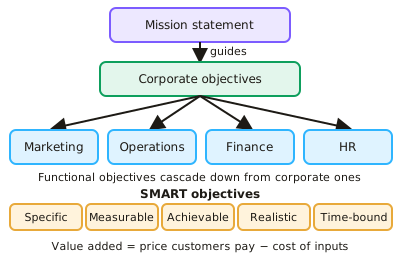
- A business adds value by converting inputs into outputs customers will pay more for; mission statements express purpose and values.
- Corporate objectives cascade into functional objectives for marketing, operations, finance and human resources; SMART objectives are specific, measurable, achievable, realistic and time-bound.
- Stakeholder and shareholder approaches differ in whose interests take priority.
- Decision making may be scientific (data-driven, using decision trees and forecasting) or based on intuition; risk and uncertainty affect both.
- Leadership styles include autocratic, paternalistic, democratic and laissez-faire; the best style depends on context, task and team.
- Opportunity cost and trade-offs feature in every significant business decision.
In more detail
- Objective cascade example: corporate objective "grow revenue by 15% in 3 years" → marketing launches two new products, operations raises capacity by 20%, HR recruits 30 staff, and finance raises £2m.
- Worked opportunity cost: a firm with £100,000 can buy a machine returning £12,000 a year or run a campaign returning £9,000. Choosing the machine has an opportunity cost of £9,000 a year.
- Scientific vs intuitive: a supermarket using loyalty-card data to plan store layouts is scientific, while a founder backing a gut feeling about a new trend is intuitive. Both carry risk.
- A-level skill: link each decision to its effect on the four functions and the firm's objectives, then judge how far it is likely to succeed.
Practice
What is business and management decision making: 7 questions
Pick an answer to check it, or open the answer for the explanation.
1. What does SMART stand for in objectives?
- Specific, Measurable, Achievable, Realistic, Time-bound
- Simple, Modern, Accurate, Rapid, Tested
- Strategic, Market, Asset, Revenue, Target
- Sales, Money, Assets, Risk, Timing
Show answer
A: Specific, Measurable, Achievable, Realistic, Time-bound. SMART objectives are easier to monitor and evaluate.
2. What is a mission statement?
- A financial forecast
- A statement of a business's purpose and values
- A marketing campaign
- A legal document
Show answer
B: A statement of a business's purpose and values. It guides objectives and decisions.
3. Which leadership style involves delegating decisions to the team with minimal direction?
- Autocratic
- Paternalistic
- Democratic
- Laissez-faire
Show answer
D: Laissez-faire. It works best with skilled, motivated teams.
4. What is the shareholder approach?
- Prioritising all stakeholder interests equally
- Prioritising returns to the owners of the business
- Ignoring profit
- Focusing only on employees
Show answer
B: Prioritising returns to the owners of the business. The stakeholder approach balances wider interests.
5. What is a decision tree used for?
- Organising staff
- Comparing options using probabilities and expected values
- Setting wages
- Advertising products
Show answer
B: Comparing options using probabilities and expected values. It supports scientific decision making under risk.
6. Which internal factor might most influence a firm's choice between an autocratic and democratic leadership style?
- The weather
- The skills and motivation of the workforce
- The exchange rate
- Foreign competition
Show answer
B: The skills and motivation of the workforce. A skilled, motivated team often responds better to a more democratic style.
7. What is a limitation of using only quantitative sales forecasts for decision making?
- They are always accurate
- They may not capture qualitative factors such as changing consumer tastes
- They take too little data into account
- They cannot be calculated
Show answer
B: They may not capture qualitative factors such as changing consumer tastes. Numbers alone may miss important contextual changes.
Keep going in Full Marks
Full Marks has 30 questions on What is business and management decision making (23 more than here), set out in practice levels. You also get notes and 3D models for all 8 subtopics of Business objectives, marketing and operations, plus games, timed exams and past papers.
On your exam board
- AQATopic 1: What is business?, Topic 2: Managers, leadership and decision making, Topic 3: Decision making to improve marketing performance, Topic 5: Decision making to improve financial performance
- OCRTopic 1.1: Types of business, objectives and stakeholders, Topic 2: Marketing, Topic 5: Accounting and finance
- EdexcelTopic 1.5: Entrepreneurs and leaders, Topic 2.3: Managing finance, Topic 2.4: Resource management
- CambridgeTopic 1: Business and its environment